
MCC & PCC Panels: Engineering Principles, Key Components, and Why Quality Matters
Introduction
In any industrial plant, whether a steel rolling mill, aluminium extrusion line, wastewater treatment facility, or plastics processing unit, two types of electrical panels are absolutely central to reliable operation: the Motor Control Centre (MCC) and the Power Control Centre (PCC). These panels are not simply boxes full of switchgear; they are engineered systems that must safely distribute electrical power, protect expensive motors and loads, and provide operators with the control and visibility needed to manage production effectively.
At ACS Engitech, MCC and PCC panel design, manufacturing, and commissioning are among our core competencies. Our panels are designed using EPLAN electrical CAD software, manufactured in our 36,000 sq. ft. Ahmedabad facility using Siemens and other premium-brand components, and tested in compliance with IEC 61439-2. This blog provides a deep technical insight into MCC and PCC panels: their architecture, key components, design principles, and the factors that distinguish a truly engineered panel from a merely assembled one.
What Is a Power Control Centre (PCC)?
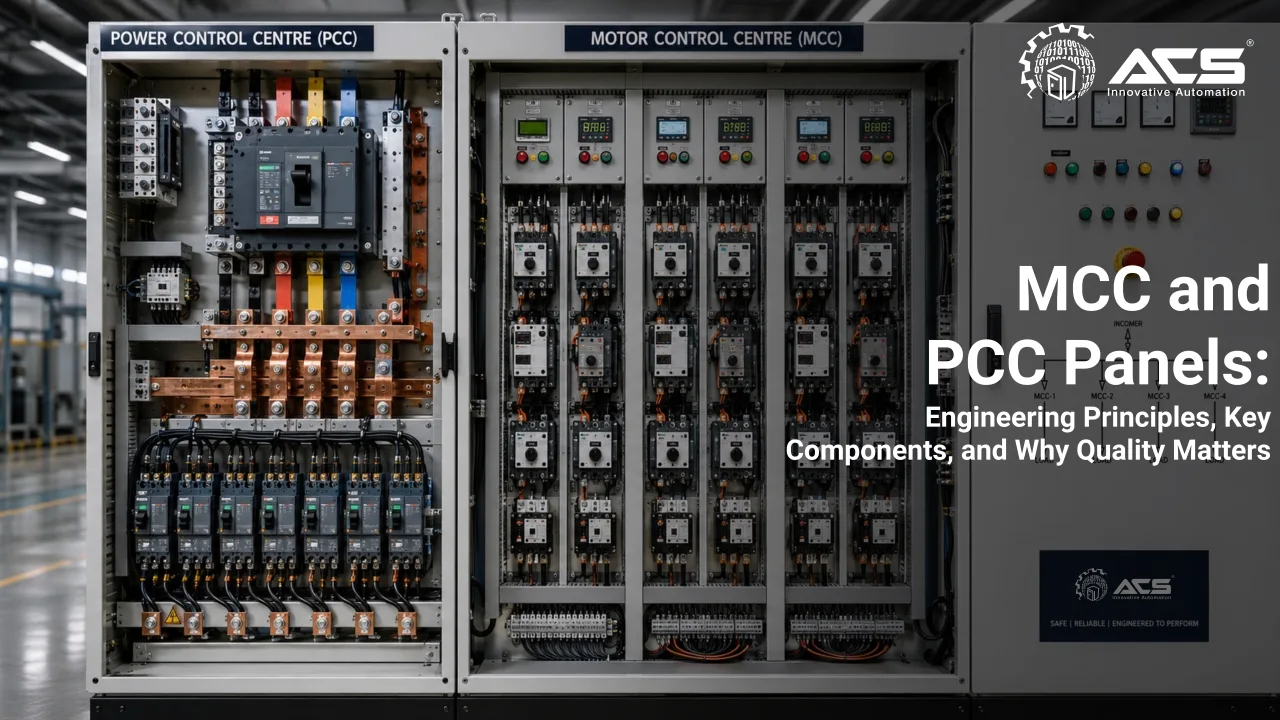
A Power Control Centre is the primary incoming power distribution panel in an industrial facility. It receives high-current power from the main transformer or utility incomer, typically at 415V AC, 3-phase, 50 Hz in India, and distributes it to downstream Motor Control Centres, sub-distribution boards, and large individual loads such as compressors, chillers, and high-power motors.
Typical PCC Architecture
A PCC panel is structured around a horizontal copper busbar system, rated at the full incomer current of the facility, commonly 2,000A, 3,200A, or higher. The busbars are supported on epoxy-glass insulators at regular intervals, with clearance distances maintained per IEC 61439 to prevent arc flash escalation under fault conditions. The incoming section houses the main Air Circuit Breaker (ACB) or MCCB for smaller installations, current transformers (CTs) for metering and protection, and the main energy metering instruments. Outgoing feeders are protected by individually rated MCCBs with adjustable overload and short-circuit protection settings.
Busbar Sizing and Short-Circuit Rating
Correct busbar sizing is one of the most critical engineering decisions in PCC design. The busbar must carry the full load current continuously without exceeding the maximum permissible temperature rise of 70°C above ambient for tinned copper conductors, as specified in IEC 61439. It must simultaneously withstand the peak short-circuit current, which can reach 50–100 kA in high-power industrial installations without mechanical deformation. ACS Engitech verifies busbar sizing through both thermal current calculations and dynamic short-circuit force analysis and validates critical panel types through short-circuit withstand and temperature rise tests conducted at CPRI Bhopal.
A correctly sized busbar system is the single most important structural component in preventing catastrophic panel failures. ACS Engitech validates critical panel designs through type testing at CPRI Bhopal under IEC 61439-2.
What Is a Motor Control Centre (MCC)?
A Motor Control Centre consolidates the starting, protection, and control equipment for multiple motors into a single engineered enclosure, located centrally in the plant electrical room. Rather than installing individual starter panels at each motor location costly, difficult to maintain, and impossible to monitor centrally, an MCC brings all motor control into one location.
Fixed vs Draw-Out MCC
MCC panels are available in two fundamental architectures. In a Fixed Type MCC, starter units are permanently wired, and the entire section must be de-energised for maintenance acceptable where motor count is moderate and planned downtime is feasible. In a Draw-Out Type MCC, each starter is mounted on a withdrawable chassis that can be removed while adjacent units remain energised, essential for continuous process industries such as wastewater treatment, aluminium processing, and chemical plants where even brief interruptions are unacceptable.
Starter Technologies Within an MCC
Each motor position within an MCC contains a starter unit that controls how the motor is started, stopped, and protected. The four principal starter types used by ACS Engitech are:
- Direct Online (DOL) Starter: Connects the motor directly to full supply voltage. The starting current is 6–8 times the full-load current. Suitable for small motors up to approximately 7.5 kW where the supply can tolerate the inrush current.
- Star-Delta (S/D) Starter: Starts the motor in star connection, reducing voltage across each winding by a factor of 1/√3, limiting starting current to approximately 33% of DOL inrush. Transfers to the delta connection as the motor reaches full speed. Suitable for 7.5–75 kW motors requiring reduced starting current. Requires a six-terminal motor winding.
- Soft Starter: An electronic device using thyristor (SCR) phase-angle control to ramp motor terminal voltage smoothly from a set initial voltage to full voltage over an adjustable ramp time of 2–30 seconds. Eliminates the current spike and mechanical torque shock of S/D switching. Ideal for pumps, conveyor belts, and fans where gradual load take-up is desirable.
- Variable Frequency Drive (VFD) Starter: Provides full variable speed control in addition to smooth starting. ACS Engitech integrates Siemens SINAMICS G120 VFDs within MCC panels for process-critical drives, offering energy savings at partial load, precise process speed control, and comprehensive motor protection functions.
Motor Protection: The Safety Architecture of an MCC
Every motor feeder in an MCC must be protected against the electrical faults that cause premature motor failures and unplanned plant stoppages:
- Overload Relay: Detects sustained overcurrent caused by mechanical overloading or voltage unbalance and trips the motor contactor before winding temperatures become damaging. ACS Engitech uses Siemens 3RU2, Schneider LRE/LRD, ABB TA25 overload relays, phase failure detection, and optional PTC thermistor input for direct motor temperature monitoring.
- Short-Circuit Protection (MCCB / SCPD): An MCCB or Short Circuit Protection Device provides instantaneous protection against bolted faults, limiting the fault energy let-through to safe levels and preventing busbar and cable damage.
- Motor Circuit Breaker: A compact combination device providing both short-circuit and overload protection in a single DIN-rail-mounted unit. The Siemens 3RV2 series, Schneider GV2 Series, ABB MS116 series, and L&K series are ACS Engitech's preferred solution for feeder currents up to 100A, offering adjustment from 0.1 to 100A directly on the device as per client requirement.
- Phase Sequence and Phase Loss Relay: Detects loss of one supply phase (single-phasing), which causes the remaining phases to carry excess current, rapidly overheating motor windings. Also prevents motor reversal caused by incorrect phase sequence after maintenance or rewiring.
- Earth Fault Relay: Detects leakage current to ground caused by insulation breakdown, providing protection against electric shock hazards and preventing insulation failure from escalating into a full earth fault.
EPLAN: The Engineering Foundation of Every ACS Panel
Every MCC and PCC panel designed by ACS Engitech is engineered in EPLAN Electric P8, the global standard for professional electrical panel documentation. EPLAN provides intelligent schematic capture with automated cross-referencing and terminal numbering; component database integration with Siemens EPLAN macro libraries for contactors, MCBs, and overload relays; and automatic generation of Bills of Materials, cable schedules, terminal diagrams, and device nameplate labels, eliminating documentation errors that arise from manual processes.
The complete EPLAN documentation package delivered with every ACS Engitech panel gives the client's maintenance team the accurate, up-to-date as-built drawings they need to troubleshoot faults rapidly and execute modifications safely, throughout the entire life of the panel.
Panel Testing and Quality Assurance
Before dispatch, every MCC and PCC panel from ACS Engitech undergoes a rigorous testing protocol aligned with IEC 61439-2:
- Insulation Resistance Test: Minimum 1 MΩ at 500 VDC between all live conductors and earth, verifying wiring insulation integrity after assembly.
- Dielectric Strength Test: 2,000V AC applied for one minute across each circuit, verifying that insulation withstand margins are adequate.
- Functional Sequence Test: Every motor starter is exercised through its complete control sequence — start, run at full load, overload trip, reset with simulated field signals. All interlocks, timers, and indicator lights are verified against the control schematic.
- IP Ingress Protection Verification: Enclosure sealing is verified for the specified IP rating. Panels for outdoor or washdown environments are tested to IP55 at ERDA.
- Thermographic Inspection: Infrared thermal imaging of busbar joints and cable terminations under load verifies adequate contact pressure and absence of hot spots before dispatch.
Conclusion
MCC and PCC panels are the circulatory and nervous system of the industrial plant's electrical infrastructure. Their quality, engineering rigour, and long-term reliability directly determine the uptime and safety of the plant they serve. The difference between a correctly engineered panel and a poorly designed one may not be visible on day one, but it becomes evident over the operating life of the plant in the form of unexpected failures, nuisance trips, motor burnouts, and, in worst cases, electrical fires and personal injuries. ACS Engitech's combination of EPLAN-based engineering, quality manufacturing with Siemens, Schneider, ABB, and L&K premium-brand components, and IEC 61439-compliant testing ensures that every panel we deliver sets the standard for safety, reliability, and lifetime value.
www.acsengitech.com