
Your Plant Has Data. Why Can’t the Shift Supervisor Answer One Simple Question?
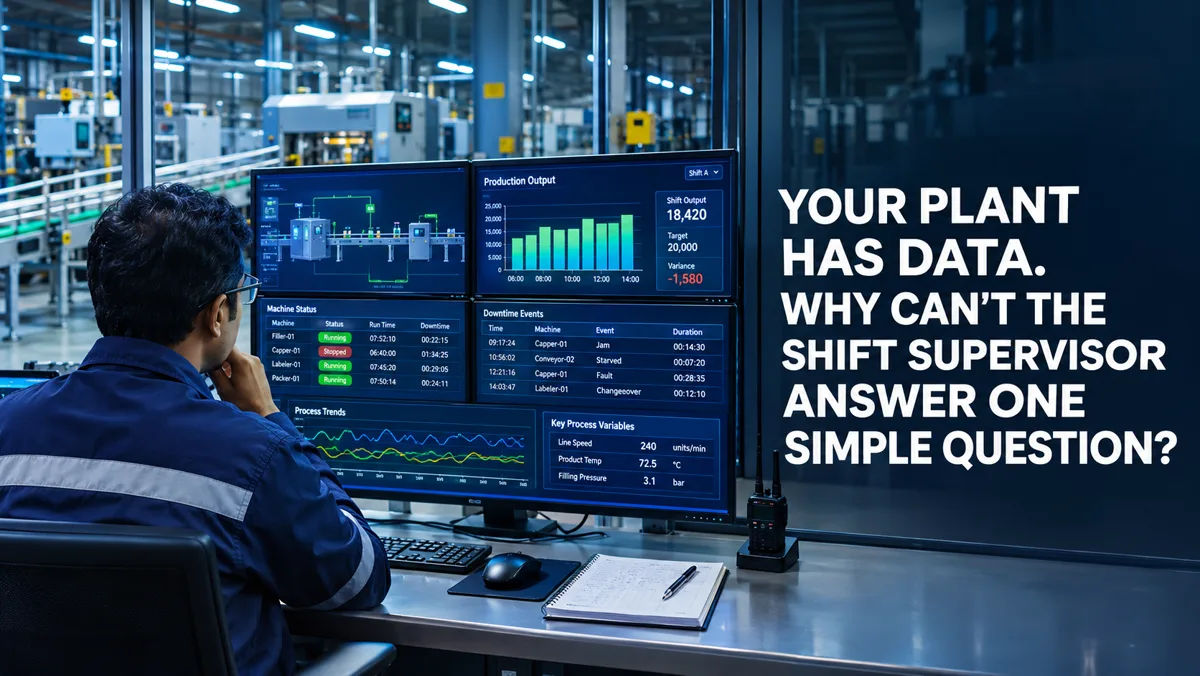
The morning meeting begins with a simple question: why did yesterday's output fall? The supervisor has a handwritten sheet, the operator remembers two machine stops and the maintenance log shows a short electrical fault. Nobody is certain whether these events describe the same incident. That uncertainty is not a failure of the people filling out forms. Often the plant has measurements but no shared definition of an event.
Start with five operational questions your team genuinely asks. How many good units did each shift produce? How long was the line waiting for material? Which machine stopped first? Was a utility constraint active at the same moment? Did the process remain within its approved parameters? Now identify the variables and timestamps needed to answer each question. A logger that records hundreds of tags without consistent context creates more files, not more clarity.
Suppose a machine records 'running' whenever its motor is energised. Production calls the same period 'idle' if no finished product comes out. Both views can be true, but they are not interchangeable. Define states such as running, starved, blocked, planned stop and fault, and decide who owns each definition. Include quality rejects, changeovers and maintenance interventions where relevant. Standardise timestamp sources, units and tag names. These decisions deserve sign-off from operations, quality, maintenance and controls teams.
A PLC may already hold important status signals. An HMI displays immediate process conditions; SCADA can collect alarms and trends; a smart data logger can capture selected production or energy information for reporting. The right combination depends on sampling needs, data retention, network architecture and system access. Avoid loading a control network with unnecessary traffic or treating every sensor reading as a business metric. Store raw values where needed, but calculate reports from documented rules.
A plant can record a five-minute stop without learning much. Add the correct timestamp and the story changes: a low-pressure alarm occurred before the motor trip, followed by a manual restart. The event sequence can guide an investigation without claiming the root cause automatically. Compare multiple signals and confirm findings with the people who were present. Event timestamps also help separate recurring issues from unrelated incidents. Teams should synchronise clocks appropriately and document any delays in data acquisition.
Choose one line and publish one report for two weeks. Compare its counts and downtime categories with manually verified records. Investigate mismatches rather than adjusting the figures to look consistent. Keep the first report simple: shift output, major stoppages, quality count and selected process variables. Ask supervisors whether they made a different decision because of it. If the answer is no, redesign the report.
The best industrial report is not the busiest. It is the one that reduces arguments about basic facts and points people towards the next useful action. Build confidence with definitions, validation and a practical pilot before expanding into broader analytics. If your shift meeting still depends on reconciling three notebooks, you have identified a worthwhile automation problem.