
Decoding Dual Standards: When to Apply IEC 60204-1 and IEC 61439-2 to Machinery Control Panels.
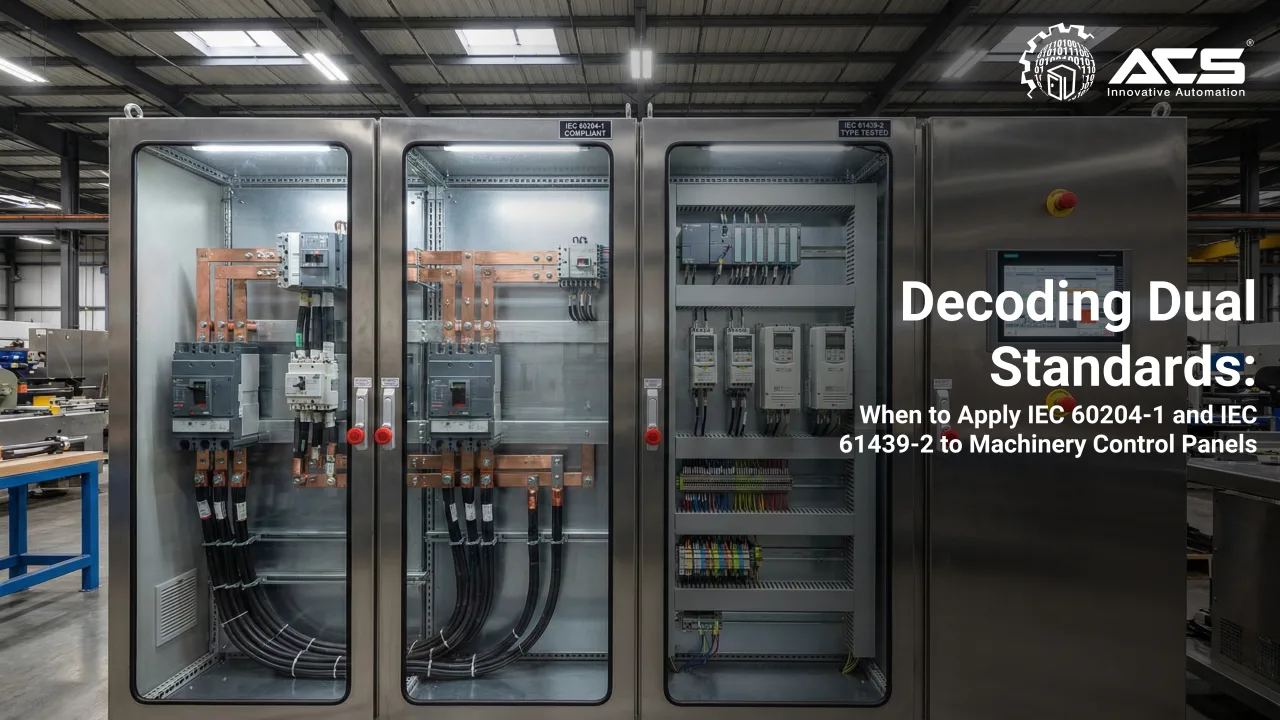
Machine builders designing control panels face a specification challenge. Multiple standards potentially apply to the same equipment. IEC 60204-1 addresses safety of machinery. IEC 61439-2 covers switchgear assemblies. When do these standards apply individually versus simultaneously?
Confusion about applicability leads to compliance gaps. These gaps create safety risks and regulatory complications.
IEC 60204-1 Scope
This standard addresses electrical equipment of machines. It covers power distribution within machinery, control circuits, sensors, actuators, and human-machine interfaces. The focus lies on protecting operators, maintenance personnel, and anyone interacting with the machine from electrical hazards.
Key requirements include proper circuit protection, emergency stop functions, control circuit integrity, enclosure protection ratings, and warning labels. The standard emphasizes functional safety—ensuring electrical systems behave predictably and provide protection during normal operations and fault conditions.
IEC 60204-1 applies when designing electrical systems integrated with mechanical equipment. Packaging machines, material handling systems, process equipment, and assembly lines all fall under this standard's scope.
IEC 61439-2 Scope
This standard addresses power switchgear and controlgear assemblies. It focuses on design verification, temperature rise verification, short-circuit performance, and protection against electric shock. The emphasis lies on the assembly's construction quality and performance under electrical stress.
Requirements include thermal performance testing, busbar sizing verification, cable entry ratings, and degree of protection (IP rating) validation. The standard ensures panels can safely distribute electrical power to connected loads.
IEC 61439-2 applies to power distribution panels regardless of whether they're part of machinery or building infrastructure. MCCs, PCCs, and distribution boards must meet these requirements.
The Overlap Zone
Machinery control panels often combine both functions. They distribute power to motors, heaters, and other loads while also providing control circuitry for automated operation. This dual function brings both standards into play.
Consider a packaging machine control panel. It contains incoming power connections, circuit breakers protecting motor circuits, VFDs controlling conveyor speeds, PLC managing sequence logic, HMI for operator interface, and emergency stop circuits.
The power distribution aspects—breakers, busbars, cable terminations—fall under IEC 61439-2. The standard requires verification that these components handle rated currents and fault currents safely.
The control system aspects—emergency stops, control circuits, safety interlocks—fall under IEC 60204-1. This standard ensures the control system provides required protective functions.
Both standards apply. Meeting one doesn't satisfy the other. Comprehensive compliance requires addressing both sets of requirements.
Risk Assessment Integration
Machinery Directive compliance requires risk assessment identifying hazards and determining necessary risk reduction measures. This assessment informs which electrical safety functions are needed.
IEC 60204-1 provides the technical requirements for implementing identified safety functions. Emergency stop categories, control circuit reliability, and safety circuit design all stem from risk assessment conclusions.
The panel must then be built to IEC 61439-2 standards ensuring physical construction adequately supports the electrical design. Thermal performance, mechanical strength, and protection rating must align with installation environment and operating conditions.
Functional Safety Considerations
Some machinery requires safety-rated control systems meeting SIL or PLr performance levels. These requirements typically come from ISO 13849 or IEC 62061.
IEC 60204-1 references these functional safety standards where applicable. Control circuit design must achieve required performance levels through component selection, redundancy, diagnostics, and proven architecture.
IEC 61439-2 doesn't directly address functional safety but influences it through reliability requirements. A panel that overheats or experiences high failure rates cannot deliver required safety performance levels regardless of control circuit design.
CE Marking Implications
CE marking for machinery requires meeting multiple directives. The Low Voltage Directive covers electrical safety. The Machinery Directive addresses machine-specific hazards. EMC Directive controls electromagnetic compatibility.
IEC 60204-1 supports Machinery Directive compliance by defining electrical safety requirements specific to machines. IEC 61439-2 supports Low Voltage Directive compliance by ensuring panel construction quality.
Technical documentation submitted for CE marking must demonstrate compliance with both standards when panels serve dual power distribution and control functions. Missing documentation for either standard creates certification gaps.
Design Documentation
IEC 60204-1 requires specific documentation including electrical diagrams, component lists, protection device settings, and safety circuit descriptions. The documentation must enable competent persons to understand system operation and perform maintenance safely.
IEC 61439-2 requires design verification documentation proving thermal performance, short-circuit withstand capability, and protection ratings. Test reports or calculation records demonstrate compliance.
Machine builders must maintain both documentation sets. Providing only control circuit diagrams without panel verification records creates incomplete technical files.
Testing Requirements
Each standard mandates specific tests. IEC 60204-1 requires functional testing of safety circuits, emergency stop validation, control circuit integrity verification, and insulation resistance measurements.
IEC 61439-2 requires temperature rise testing, short-circuit withstand testing, dielectric strength testing, and protection rating verification.
Comprehensive commissioning must address all testing requirements. Skipping either set leaves compliance uncertain.
The Component Selection Challenge
Components must satisfy both standards' requirements. A motor contactor must handle specified electrical ratings (61439-2) while also providing reliable operation for safety-critical control circuits (60204-1).
This dual requirement sometimes conflicts. A component meeting minimum 61439-2 specifications might have reliability characteristics inadequate for 60204-1 safety circuit applications. Conversely, components selected primarily for control reliability must still meet thermal and electrical ratings.
Resolution requires examining both standards during specification. Select components satisfying all applicable requirements rather than choosing based on single criteria.
Installation Environment Impact
Operating environment affects both standards' application. Dust, moisture, temperature extremes, and corrosive atmospheres all influence panel design requirements.
IEC 60204-1 addresses these factors through IP rating requirements and material selection criteria. Control devices must function reliably in the specified environment.
IEC 61439-2 addresses them through protection degree verification and material specifications. Panel enclosures must maintain integrity under environmental stresses.
Both perspectives matter. A panel with adequate IP rating for dust ingress protection (60204-1) must also demonstrate that this protection doesn't compromise thermal performance under load (61439-2).
Maintenance Accessibility
IEC 60204-1 emphasizes safe maintenance access. Circuit isolation, lockout provisions, and clear identification enable safe service work.
IEC 61439-2 addresses physical access through internal barrier requirements and terminal accessibility specifications.
Panel layout must satisfy both requirements simultaneously. Maintenance technicians need safe access to both power distribution components and control circuits without compromising either standard's protective requirements.
The Contractor's Dilemma
Electrical contractors installing machinery sometimes receive incomplete specifications. The machine builder provides control schematics meeting 60204-1 but doesn't provide 61439-2 verification for the panel enclosing those circuits.
This gap places contractors in difficult positions. They're responsible for safe installations but lack information confirming panel compliance. Requesting verification documentation before installation protects all parties.
Small Machine Exemptions
Some machinery operates on standard branch circuits without requiring dedicated power distribution panels. In these cases, 61439-2 may not apply to machine-specific equipment.
However, 60204-1 still governs the machine's electrical system design. Control circuits, safety functions, and operator interfaces must meet its requirements regardless of power source simplicity.
The Standards Evolution
Both standards undergo periodic revisions. Current editions supersede older versions with updated requirements. Determining which edition applies to specific machinery depends on manufacturing date and jurisdiction.
Some markets allow older equipment to remain compliant with standards applicable during its manufacture. Others require upgrades when standards change. Understanding these transitions prevents surprises during facility audits or equipment modifications.
Practical Compliance Approach
Machine builders should designate someone responsible for understanding both standards' requirements. This individual reviews designs ensuring all applicable requirements are addressed.
Checklists covering both standards streamline the review process. Each requirement gets checked against the design. Gaps identified early cost less to address than those found during testing or field installation.
Third-party reviews by independent consultants or certification bodies provide additional confidence. Their perspective catches requirements that internal reviewers might overlook.
Cost Implications
Comprehensive compliance costs more than minimal approaches. Testing, documentation, and specification development all require investment. However, these costs represent a small fraction of machine value while preventing large risks.
Non-compliance creates multiple cost exposures: certification delays, customer rejections, field modifications, liability claims, and regulatory penalties. Any of these exceed prevention costs substantially.
The Market Reality
Markets with strong regulatory enforcement demand demonstrated compliance. Northern European countries, North America, and Australia scrutinize machinery certifications closely. Shortcuts get caught and penalized.
Other markets have less enforcement. Temptation exists to skip verification and testing. This short-term cost reduction creates long-term risks when equipment fails or accidents occur.
Organizations building global reputations cannot afford inconsistent compliance approaches. Markets eventually converge toward higher standards. Leading rather than following this convergence provides competitive advantage.
Moving Forward
The interaction between IEC 60204-1 and IEC 61439-2 requires systematic attention during machinery design. Treating them as separate independent requirements misses their overlap and can leave gaps.
An integrated approach addressing both simultaneously from project start produces better outcomes than addressing them sequentially. Machine reliability and operator safety both benefit from comprehensive electrical system design meeting all applicable standards.
The question is whether to invest in proper compliance infrastructure now or pay higher costs for retrofits, failures, and accidents later.
About ACS Engitech:
We design control panels for OEMs requiring compliance with both IEC 60204-1 for machinery safety and IEC 61439-2 for power distribution performance. Our design process using EPLAN software incorporates both standards' requirements from initial concept through final documentation. We develop control philosophy documentation, prepare I/O lists, design electrical schematics, and verify thermal performance to meet comprehensive compliance requirements. Our manufacturing facility produces panels tested to both standards with documented verification reports. We have supplied automation panels to packaging machinery manufacturers, material handling system builders, and process equipment fabricators requiring certified compliance for global markets.
Need control panels meeting both machinery safety and power distribution standards?
Discuss your project requirements with our team specializing in dual-compliant panel design and manufacturing.
📧 Email: sales@acsengitech.com | satish@acsengitech.com 📞 Phone: +91-990-902-7347 🌐 Visit: www.acsengitech.com
#MachineryDesign #ComplianceEngineering #OEMSupport #Gujarat #ControlSystems #SafetyFirst #Ahmedabad