
IEC 61439 Explained: Why Control Panel Compliance Is Non-Negotiable for Industrial Safety
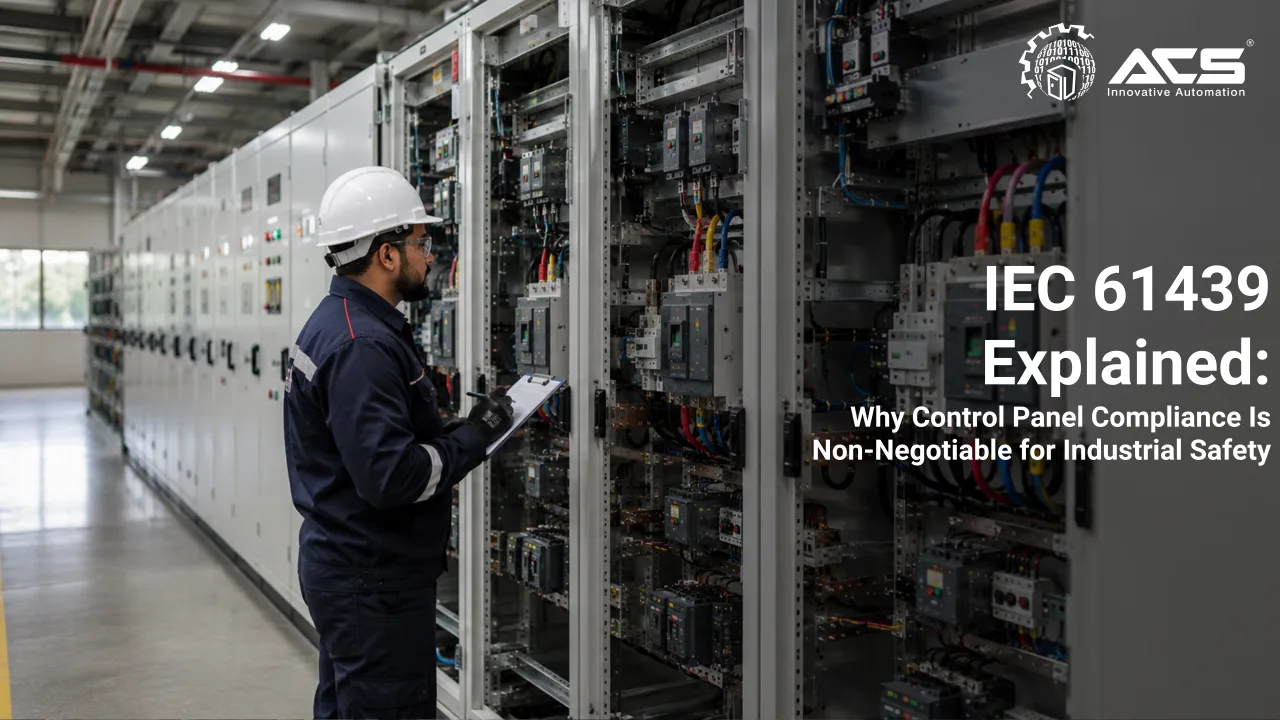
Introduction
In today's competitive industrial landscape, the integrity of electrical control panels is not merely a matter of engineering preference, it is a legal, safety, and performance imperative. The IEC 61439 standard, titled 'Low-Voltage Switchgear and Controlgear Assemblies,' is the internationally recognized framework that defines how power distribution and control equipment must be designed, manufactured, and verified. At ACS Engitech, every MCC Panel, PCC Panel, PLC Panel, and Drive Panel we manufacture is built and rigorously tested in compliance with this standard.
This blog breaks down what IEC 61439 means, why it matters for plant operators and OEMs, and how compliance protects people, equipment, and business continuity.
What Is IEC 61439?
The IEC 61439 series replaced the older IEC 60439 standard. It was developed to provide a clearer and more robust framework for the verification of low-voltage assemblies. The standard applies to assemblies used at voltages up to 1,000V AC or 1,500V DC.
The series is divided into multiple parts:
- IEC 61439-1: General rules applicable to all assemblies
- IEC 61439-2: Power switchgear and control gear assemblies (PSCBA), covers MCC and PCC panels
- IEC 61439-3: Distribution boards intended for operation by ordinary persons
- IEC 61439-4: Particular requirements for assemblies for construction sites
- IEC 61439-5: Assemblies for power distribution in public networks
- IEC 61439-6: Busbar trunking systems
Key Verification Methods Under IEC 61439
Unlike its predecessor, IEC 61439 introduces a structured system of verification through three distinct methods:
1. Type Testing
This involves physical testing of a representative assembly or sub-assembly in an accredited laboratory. Tests include temperature rise, short-circuit withstand strength, insulation properties, and IP (Ingress Protection) rating. ACS Engitech conducts short-circuit and temperature-rise tests at CPRI Bhopal and IP55 protection testing at ERDA, two of India's most reputable testing laboratories.
2. Design Verification
Calculations and engineering analysis are used to verify performance characteristics without full testing. This is particularly applicable when the design is a variation of a pre-tested assembly. Parameters like thermal current ratings, busbar sizing, and creepage distances are verified analytically.
3. Assessment of Similar Design
Comparisons are made with previously tested designs to confirm compliance of modified assemblies, reducing time and cost without compromising safety.
Why IEC 61439 Compliance Matters
A non-compliant panel may pass initial inspection but fail catastrophically under overload or short-circuit conditions, putting lives and assets at risk.
Here is why compliance is critical:
- Worker Safety: Verified assemblies are designed to contain arc faults and prevent electrical fires, protecting plant personnel.
- Equipment Longevity: Properly rated busbars, contactors, and insulation materials reduce thermal stress, extending equipment life.
- Insurance and Legal Liability: In the event of an incident, non-compliant panels can invalidate insurance claims and expose businesses to legal liability.
- Export Readiness: International clients and EPC companies require certified panels, making IEC 61439 compliance a prerequisite for global projects.
- Operational Reliability: Verified panels are less likely to trip unexpectedly, reducing costly plant downtime.
ACS Engitech's Compliance Process
At ACS Engitech, our 36,000 sq. ft. manufacturing facility is equipped with calibrated tools and a quality management system certified under ISO 9001:2015. Our engineering team uses EPLAN software for accurate electrical schematic design, ensuring that every conductor cross-section, busbar dimension, and device rating is correctly specified before manufacturing begins.
Each panel undergoes a multi-stage inspection process, including:
- Component verification against the Bill of Materials
- Wiring continuity and insulation resistance testing
- Functional testing of control logic and interlocks
- Thermographic scanning for hot spots
- Final IP rating verification and documentation
The Business Impact of Using Compliant Panels
Plant owners and engineering contractors often focus on upfront panel cost, but the Total Cost of Ownership (TCO) of a compliant panel is significantly lower over a 10–15-year lifecycle. Reduced maintenance interventions, fewer unplanned outages, and elimination of insurance and legal risks all contribute to a strong ROI on quality-built, IEC 61439-certified assemblies.
Conclusion
IEC 61439 is not bureaucratic paperwork, it is the engineering foundation of safe, reliable, and legally defensible electrical infrastructure. Whether you are an OEM building industrial machinery or an EPC contractor commissioning a greenfield plant, insisting on IEC 61439-compliant control panels is one of the best investments you can make. At ACS Engitech, compliance is not an afterthought, it is built into every process, from design to delivery.
Contact ACS Engitech to learn how our IEC 61439-compliant panels can safeguard your plant operations and meet the most stringent global project requirements.
www.acsengitech.com