PROFINET vs Modbus vs EtherNet/IP: Choosing the Right Industrial Fieldbus for Your Plant
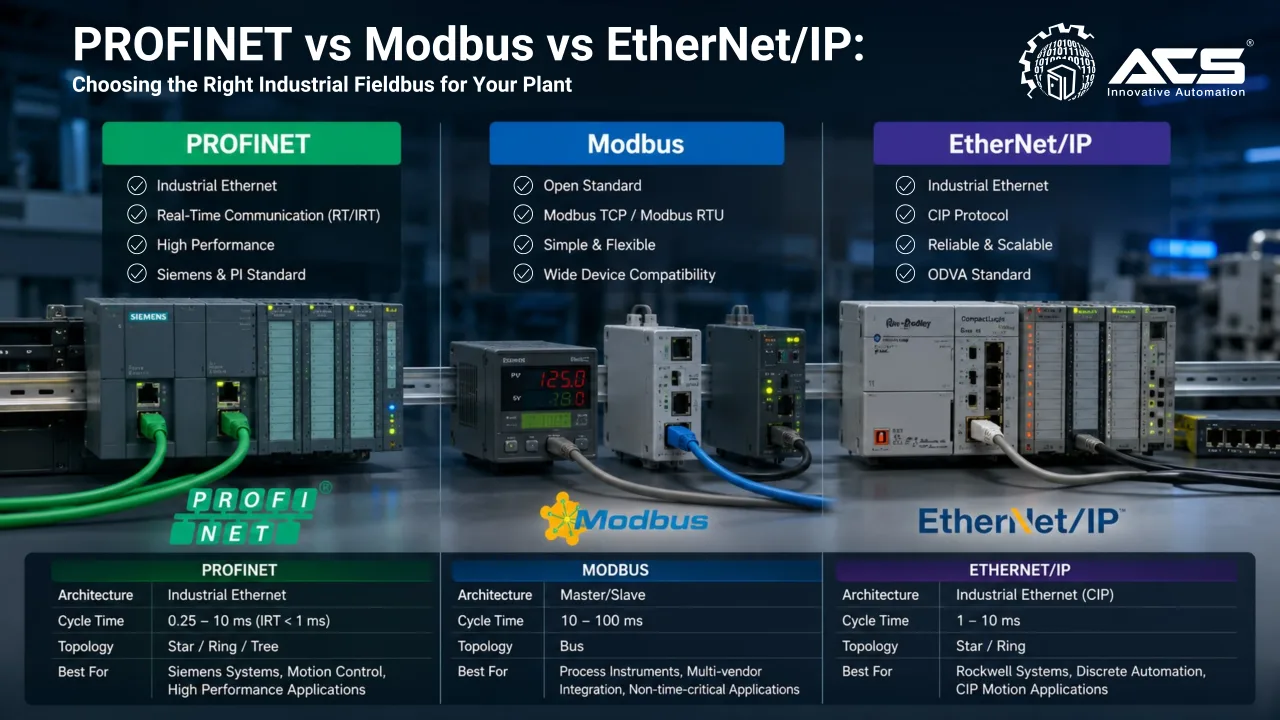
Introduction
In industrial automation, the choice of communication protocol is one of the most consequential architectural decisions you will make. It determines the speed of data exchange between devices, the complexity of network setup, the availability of diagnostic tools, and the ease of future expansion. At ACS Engitech, we work with PROFINET, Modbus TCP/RTU, USS, and EtherNet/IP across diverse industries, and understanding the strengths and limitations of each is central to our system integration expertise.
This blog provides a comprehensive technical comparison of three dominant protocols: PROFINET, Modbus, and EtherNet/IP. We will examine their architecture, performance characteristics, suitability for different applications, and the practical considerations that should drive your selection.
1. Modbus: The Veteran Protocol That Refuses to Retire
Modbus was developed by Modicon (now Schneider Electric) in 1979 and remains one of the most widely deployed industrial communication protocols in the world. Its longevity is a testament to its simplicity and openness.
Architecture
Modbus operates on a master-slave model. A single master device (typically a PLC or SCADA system) polls one or more slave devices (instruments, drives, remote I/O). Communication can occur over:
- Modbus RTU: Serial communication over RS-485 or RS-232, supporting up to 247 slave devices per network segment.
- Modbus ASCII: A less common variant using ASCII encoding, typically for applications with poor EMI conditions.
- Modbus TCP: Modbus encapsulated within TCP/IP packets, running on standard Ethernet infrastructure.
Performance
Modbus RTU operates at baud rates up to 115,200 bps. Modbus TCP, running on 100 Mbps Ethernet, achieves significantly higher throughput, though response times in the 10–50 ms range are typical for multi-slave networks.
Best For
Modbus is ideal for connecting process instruments (flow meters, temperature transmitters, pressure sensors), variable frequency drives, and energy meters to SCADA systems. It is the protocol of choice where device density is moderate, real-time performance is not critical, and interoperability across multi-vendor environments is required.
ACS Engitech uses Modbus TCP/RTU extensively for process instrumentation integration and energy monitoring systems where devices from multiple manufacturers must co-exist.
2. PROFINET: The High-Performance Industrial Ethernet Standard
PROFINET (Process Field Network) was developed by the PROFIBUS and PROFINET International (PI) organisation and is the industrial Ethernet standard championed by Siemens and many other European automation vendors. It is the dominant protocol within the Siemens TIA Portal ecosystem.
Architecture
PROFINET operates on standard Ethernet hardware (IEEE 802.3) with specific real-time extensions. It supports three communication classes:
- TCP/UDP/IP: Standard IT communication used for parameterization and acyclic data exchange, typical cycle times >100 ms.
- RT (Real-Time): Cyclic data exchange for standard I/O with cycle times from 1–10 ms, using software-only real-time mechanisms without special hardware.
- IRT (Isochronous Real-Time): Hardware-level time synchronization using special ASIC-equipped switches, achieving cycle times below 1 ms with jitter under 1 µs essential for high-speed CNC and multi-axis servo synchronization.
Performance
PROFINET RT achieves typical cycle times of 1–4 ms for standard machine I/O. PROFINET IRT achieves sub-millisecond cycles with deterministic synchronization across hundreds of drives and I/O modules, a level of performance that Modbus and standard EtherNet/IP cannot match.
Best For
PROFINET is the protocol of choice for machine automation with Siemens PLCs, servo motion control (SINAMICS S120 via PROFINET IRT), intelligent decentralized I/O (ET 200SP, ET 200MP), and applications requiring deterministic, high-speed control loops. It also supports parallel IT communication over the same cable, enabling seamless IIoT data collection without additional infrastructure.
3. EtherNet/IP: The North American Industrial Ethernet Contender
EtherNet/IP (Ethernet Industrial Protocol) was developed by Rockwell Automation and is managed by ODVA. It is the dominant industrial Ethernet protocol in North American markets and is widely used with Allen-Bradley PLCs and devices from Omron, Cognex, and many sensor manufacturers.
Architecture
EtherNet/IP uses the Common Industrial Protocol (CIP) application layer, running over standard TCP/IP and UDP/IP. It supports:
- Explicit Messaging (TCP): For acyclic data transfer such as configuration and diagnostics.
- Implicit Messaging (UDP): For cyclic, real-time I/O data exchange.
Performance
EtherNet/IP achieves typical I/O cycle times of 1–10 ms for standard I/O. For motion control (CIP Motion), the protocol achieves cycle times down to 250 µs on dedicated hardware, making it competitive with PROFINET IRT in Rockwell-centric motion systems.
Best For
EtherNet/IP is the natural choice when integrating Allen-Bradley PLCs, Cognex vision systems, and other ODVA-member devices. Its rich ecosystem of conformance-tested devices and strong ODVA certification program ensures interoperability.
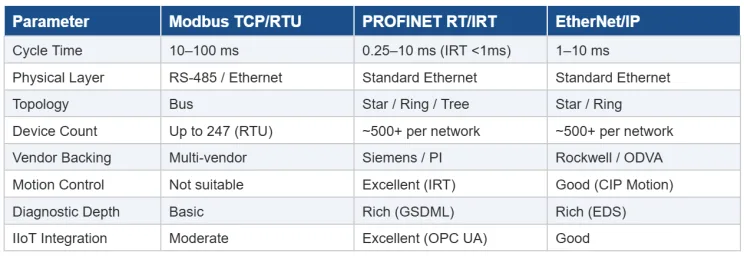
Side-by-Side Comparison
The table below summarizes the key technical differences:
Making the Right Choice
The selection of a fieldbus protocol should be driven by the requirements of your specific application:
- Choose Modbus TCP/RTU when connecting process instruments from multiple vendors in a non-time-critical environment, or for energy monitoring applications.
- Choose PROFINET when building Siemens-based automation systems, deploying servo motion control, or requiring the deepest diagnostic integration and IIoT connectivity.
- Choose EtherNet/IP when your control infrastructure is Allen-Bradley-centric or when using Cognex vision systems, barcode readers, and other ODVA-member devices.
Conclusion
There is no universally superior fieldbus, the best protocol is the one that matches your application requirements, device ecosystem, and future expansion strategy. ACS Engitech's system integration expertise spans all three protocols, enabling us to design communication architectures that are optimally suited to each project. Our experience with Siemens PROFINET in particular, from basic S7-1200 networks to high-speed IRT servo systems, allows us to deliver automation solutions with the performance and reliability that modern industry demands.
www.acsengitech.com