
Panel Wiring Standards: Why Ferrules and Color Coding Actually Matter Beyond Aesthetics
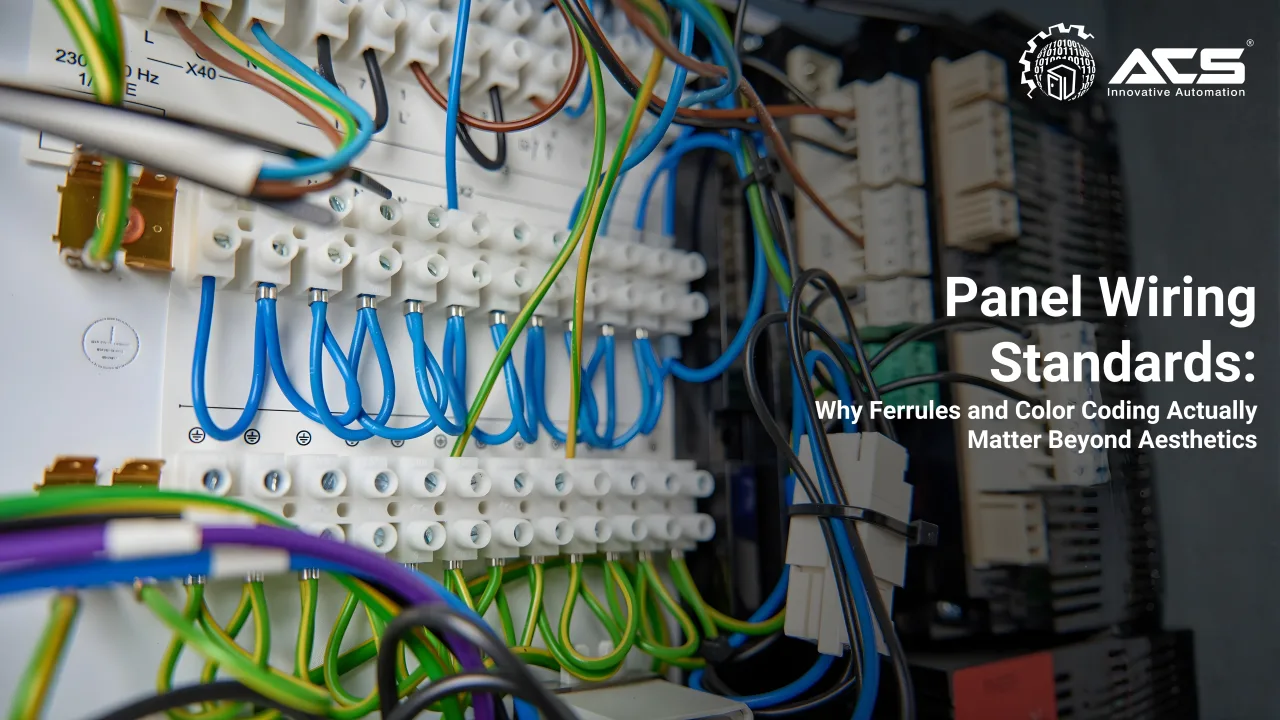
Control panel wiring standards might seem like aesthetic concerns, neat cable routing and consistent colors look professional, but appear functionally unnecessary if connections are electrically correct. This perspective misses how wiring quality directly affects operational availability through its impact on troubleshooting efficiency and long-term reliability.
Proper wiring practices follow multiple standards simultaneously, color coding for circuit identification, wire ferrules for termination reliability, logical terminal block arrangement for intuitive troubleshooting, proper cable routing separating power and control circuits, and comprehensive documentation matching installed conditions. Each standard serves specific purposes beyond appearance.
Wire color coding provides instant circuit identification without consulting documentation. International standards specify blue for neutral, green-yellow for ground, and black or brown for live conductors in power circuits. Control circuits typically use orange, with variations indicating specific functions. These conventions allow maintenance electricians to immediately identify circuit types during troubleshooting without tracing connections.
We recently analyzed troubleshooting time across multiple installations with varying wiring quality. Three wastewater treatment facilities with similar automation complexity but different panel manufacturers provided the comparison. Facility A had panels manufactured to strict standards with consistent color coding, comprehensive labeling, and proper ferrule identification. Facility B had functional panels but inconsistent colors and minimal labeling. Facility C had adequate but basic wiring.
Over twelve months, the average fault troubleshooting time at Facility A was 32 minutes per incident. Facility B averaged 85 minutes, and Facility C averaged 78 minutes. The difference stemmed directly from wiring quality at Facility A, maintenance teams identified faulty circuits visually and confirmed connections quickly. At Facilities B and C, teams spent substantial time tracing wires, confirming circuit functions, and verifying connections against drawings before beginning actual repairs.
The operational impact multiplies during emergency situations. During normal business hours with engineering support available, poor wiring creates delays but usually gets resolved. At 2 AM during production shifts, when the on-call electrician is the only resource, wiring quality determines whether production resumes in 30 minutes or 3 hours. The production loss difference far exceeds panel manufacturing cost differences.
Ferrules serve specific reliability functions beyond identification. A wire termination without a ferrule relies on individual copper strands making contact with terminal screws. Some strands might not fully engage, creating high-resistance connections that heat over time. Proper ferrules crimp all conductors uniformly, ensuring full contact area. The termination reliability improves substantially.
Wire identification through ferrule labels eliminates ambiguity. In a control panel with 200 terminals, finding where a specific signal originates requires either comprehensive labeling or extensive wire tracing. Ferrules printed with terminal numbers matching EPLAN documentation allow immediate identification. The 3-5 seconds per ferrule investment during manufacturing saves hours during panel life.
Terminal block organization affects intuitive troubleshooting. Logical arrangements group related circuits, all motor contactors in one section, all sensor inputs in another section, all control outputs in a third section. This organization lets electricians quickly locate relevant terminals when diagnosing issues. Random terminal assignment forces reference to drawings for every troubleshooting step.
Cable routing separates high-power and control circuits, preventing electromagnetic interference and improving safety. Power cables carrying motor current should route separately from signal cables carrying sensor data. Parallel routing of power and signal cables in the same trunking invites noise pickup that creates intermittent control issues difficult to diagnose. Proper routing prevents these problems from occurring.
Wire length management prevents multiple issues. Excess wire length creates tangled bundles that complicate troubleshooting and restrict airflow. Insufficient length creates tension on terminals and prevents future modifications. Optimal practice provides enough length for neat routing with slight slack at terminals, allowing easy disconnection without excessive coiling.
Cable identification beyond ferrules helps during major modifications or troubleshooting. Multi-conductor cables in control panels might carry signals between terminal blocks, PLCs, and field connections. Proper practice labels cables at both ends, ideally with source and destination information. This identification dramatically reduces the time needed to understand signal paths during modifications.
Grounding practices affect both safety and noise immunity. Proper ground bus installation with single-point grounding for control circuits reduces ground loops that create control noise. All ground connections should show clear continuity to the main ground bus. Inadequate grounding creates both safety concerns and intermittent control problems from electrical noise.
Documentation alignment with physical installation matters significantly. EPLAN or AutoCAD drawings show terminal assignments, wire numbers, and color codes. If installed panels match drawings exactly, troubleshooting becomes straightforward consult the drawing, locate the terminal, and verify the circuit. If panels deviate from drawings due to field changes or poor quality control, drawings lose value, and troubleshooting becomes empirical exploration.
We manufacture panels using ISI-marked flexible copper cables with proper color coding black for line conductors, blue for neutral, green-yellow for ground, and orange for control circuits. All wire terminations use copper-crimped ferrules with printed identification matching EPLAN terminal numbers. Terminal blocks follow logical arrangements documented in panel layouts. These practices add approximately 8-10% to manufacturing cost compared to basic functional wiring.
The cost justification becomes obvious when comparing troubleshooting efficiency. A plant operating 16 hours daily, generating 60,000 rupees revenue per hour, experiences an average of two panel-related faults monthly, requiring 90 minutes of troubleshooting time with basic wiring. That's 3 hours monthly downtime, representing 180,000 rupees lost production. Reducing troubleshooting time to 35 minutes saves 110 minutes monthly, 110,000 rupees. The panel might have cost 20,000 rupees more initially for proper wiring, paying back within two months through reduced troubleshooting time.
Quality inspection during panel manufacturing ensures standards are followed. We use digital multimeters to check continuity on every connection, megger testing insulation resistance between phases and ground, and visual inspection verifying color coding, ferrule installation, and routing standards. This inspection adds time during manufacturing but prevents field issues from poor workmanship.
Customer education helps set appropriate expectations. Some customers initially resist paying for proper wiring standards, viewing them as unnecessary cosmetics. Explaining the relationship between wiring quality and troubleshooting efficiency helps customers understand they're purchasing operational availability, not just neat appearance. Case studies from similar applications demonstrate the long-term value.
About ACS Engitech: We manufacture control panels following comprehensive wiring standards, including ISI-marked color-coded cables, copper-ferruled terminations with EPLAN-matched identification, logically arranged terminal blocks, proper separation of power and control circuits, and documentation that accurately reflects installed conditions. These practices increase manufacturing cost marginally but reduce troubleshooting time by approximately 60% during panel operational life, a cost-benefit ratio that improves facility availability and prevents production losses during maintenance activities. Our commitment to wiring standards reflects an understanding that panel value extends far beyond initial commissioning into years of reliable operation with efficient maintenance.
📧 Email: sales@acsengitech.com | satish@acsengitech.com 📞 Phone: +91-990-902-7347 🌐 Visit: www.acsengitech.com