
The Factory Expansion Trap: Why a New Machine Needs an Automation Readiness Check
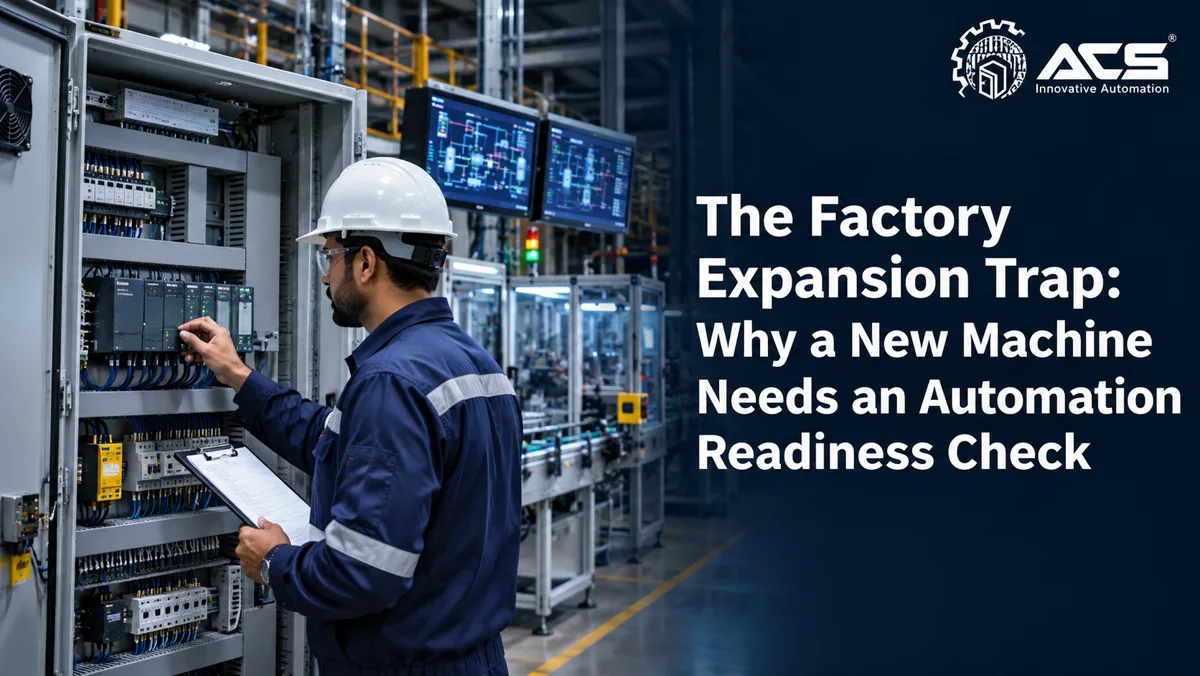
A factory may order a second production line because the first is fully booked. The mechanical layout looks feasible, the purchase order is signed and commissioning has a date. Then the electrical team discovers that the existing control panel has no spare I/O, the network cabinet is full and an upstream conveyor must change its sequence. The new machine is not necessarily the problem. The missing interface decisions are.
Draw a line around what the new equipment needs to receive and what it must send. Material availability, start permission, emergency-stop status, fault reset, production counts and recipe selection are all potential interfaces. Which signals are hardwired? Which must travel over an industrial network? What happens when the upstream machine stops but the downstream equipment still contains material? Write the answers in ordinary language first, then translate them into a signal list.
A vacant section inside an enclosure does not automatically mean the system is ready. Check power demand, available feeder capacity, cable routes, heat dissipation, short-circuit considerations and planned maintenance access. In the PLC system, confirm spare input/output points, processing capacity, communication ports, supported protocol versions and software licensing. Ask whether the existing operator interface can display new alarms or whether a new station is needed. For equipment destined for an international installation, document destination-specific electrical requirements early.
One of the most expensive ambiguities is the word 'automatic'. For a connected line, who starts the sequence? Is there one master controller, or does each machine own its local logic and exchange permissions? Which controller records the batch complete signal? Who can override a sensor during maintenance? These are engineering decisions with operational consequences. A control responsibility matrix records each function, the equipment owner, the associated input and the required failure response. It also exposes gaps before anyone starts programming.
Before finalising the architecture, choose three uncomfortable scenarios. A proximity sensor fails during a shift. A network link disappears between the new and existing machines. Utility pressure drops during a batch. Ask operators, maintenance staff and suppliers to describe the intended safe response and recovery steps. This is not a replacement for formal risk assessment or safety engineering. It is a practical way to expose unclear assumptions.
We recommend a staged plan: drawings and interface approval, panel checks, I/O verification, communication testing, dry-run sequences, product trials and operator handover. Capture an as-built backup and a clear fault list before the first production shift. A commissioning record should identify what was tested, the outcome and any open items. This protects both plant staff and the machine supplier against conflicting recollections later.
The useful question is not 'Can we fit one more machine?' It is 'Can the plant operate, maintain and recover the expanded process as one system?' Put the electrical, controls, production and maintenance teams in the same review. An hour spent on assumptions at the beginning is worth more than a polished drawing that ignores them.