
Type 2 Coordination: The Motor Protection Standard That Prevents Downtime Beyond MCB Ratings.
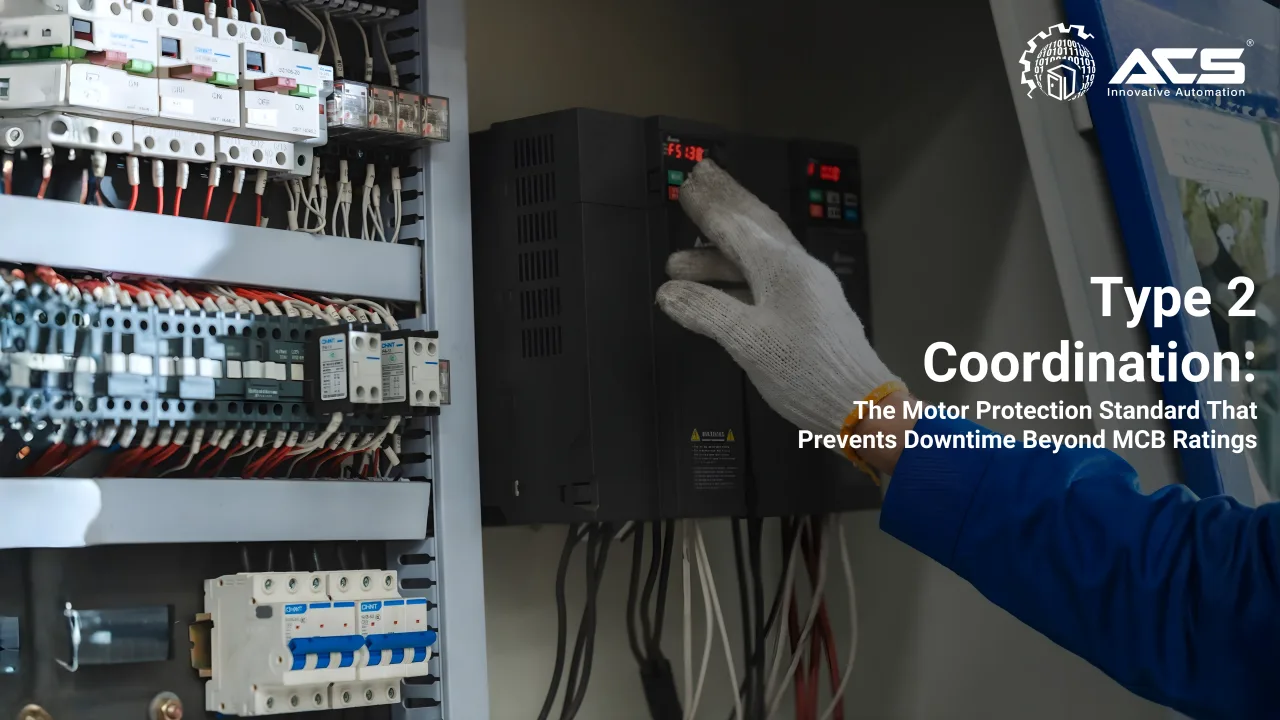
Electrical protection standards contain subtle specifications that dramatically affect operational availability. Type 2 coordination represents one such specification often overlooked during design but critically important when motor faults occur in production environments.
Motor control circuits combine protective devices, contactors, and overload relays. During normal operation, contactors switch motor current while protective devices remain inactive. During fault conditions—short circuits or ground faults protective devices must interrupt fault current while protecting downstream components. The coordination between these devices determines what happens after fault clearing.
Type 1 coordination means protective devices clear faults without endangering personnel and without damage beyond repair to control components. The contactor and overload relay might require replacement after a severe fault, but no fire or shock hazard occurs. This minimum standard protects safety but allows component damage that requires maintenance before resuming operation.
Type 2 coordination adds the requirement that contactors and overload relays remain operable after fault clearing, with possible contact welding limited. In practical terms, after a short circuit fault, you can restart the motor circuit immediately without replacing components. The production loss is limited to the time needed to identify and isolate the faulty motor, not the additional hours needed to replace contactors and rewire circuits.
The distinction matters during actual production interruptions. Consider a motor winding failure that creates a phase-to-phase short circuit. With Type 1 coordination, the protective device clears the fault, but the contactor suffers internal damage from the fault current. Maintenance must replace the contactor, order or retrieve the correct part, rewire connections, and test before returning to service. This process might require 3-6 hours minimum, often longer if replacement parts aren't readily available.
With Type 2 coordination, the same fault gets cleared by protective devices while the contactor remains functional. After identifying the faulty motor and isolating it, production resumes immediately. The downtime might be 15-30 minutes instead of multiple hours. For a production line generating 50,000 rupees in revenue per hour, this difference is substantial.
Achieving Type 2 coordination requires matching specific protective devices with specific contactors and overload relays. Manufacturers publish coordination tables showing verified combinations. A Siemens 3RV2 circuit breaker with a 3RT2 contactor and 3RU2 overload relay forms a Type 2 coordinated unit for motors up to specific frame sizes. Using arbitrary combinations, even from the same manufacturer, doesn't guarantee coordination.
We recently commissioned an MCC panel for a plastic extrusion facility with six extruder lines. The specification required Type 2 coordination for all motor feeders from 5 HP to 100 HP. This meant carefully selecting protective devices and contactors based on manufacturer coordination tables, not just current ratings and short circuit capacity. The incremental cost was perhaps 8-10% above Type 1 components.
Six months after commissioning, one extruder motor experienced winding failure during production, creating a phase-to-phase fault. The MCCB cleared the fault immediately. The contractor showed no visible damage and tested normally. They isolated the damaged motor, redirected production to the remaining lines, and resumed within 20 minutes. Type 2 coordination prevented multi-hour downtime while sourcing and replacing a contactor.
Panel manufacturers sometimes overlook coordination requirements, focusing on individual component ratings. A 60A MCCB with appropriate short circuit capacity, a 50A contactor rated for AC-3 duty, and a 40-63 An overload relay all seems appropriately sized for a 40 HP motor. But unless these specific components appear together in coordination tables, Type 2 performance isn't guaranteed. Component ratings alone don't ensure coordination.
Testing requirements differ between coordination types. Type 1 requires testing to 10x motor current or the prospective short circuit current, whichever is lower. Type 2 requires the same testing but with additional requirements that contractors remain operational. Manufacturers conduct these tests and publish results. Panel builders and end users rarely have the capability or need to test independently.
Cost implications extend beyond component prices. Type 2 coordination might require slightly larger contactors or more expensive MCCBs compared to Type 1 assemblies. For a typical MCC panel with 20 motor feeders, the total incremental cost might be 40,000-60,000 rupees. Compare this against a single production interruption costing 100,000+ rupees in lost revenue, and the cost justification becomes clear.
Documentation matters for verifying coordination. Properly engineered panels should include coordination tables showing the specific combination of protective device, contactor, and overload relay for each motor feeder, along with references to manufacturer coordination data. This documentation proves compliance and helps maintenance teams order correct replacements.
Retrofit situations present challenges. Existing MCC panels might have adequate protective devices but lack Type 2 coordination. Upgrading might require replacing contactors, protective devices, or both to achieve verified combinations. The investment usually justifies itself through reduced downtime risk, particularly for critical production equipment.
Some applications prioritize Type 2 coordination more than others. Continuous process industries chemical production, water treatment, and paper manufacturing, suffer severely from unexpected downtime. Equipment redundancy might allow production to continue with one motor down, but replacing components extends outages significantly. These applications benefit most from Type 2 coordination investment.
Safety considerations remain paramount. Both Type 1 and Type 2 coordination provide adequate personnel protection they prevent fire and shock hazards. The distinction is purely operational whether components remain serviceable after clearing faults. Neither type compromises safety, but Type 2 adds operational reliability.
About ACS Engitech: We design and manufacture MCC panels with Type 2 coordination as a standard specification for production-critical motor feeders. Our component selection follows manufacturer coordination tables, ensuring protective devices and contactors form verified Type 2 combinations. This approach adds minimal cost during manufacturing but prevents the extended production interruptions that occur when motor protection components fail after clearing short circuit faults. For Gujarat's manufacturing facilities, where downtime directly impacts revenue, Type 2 coordination represents essential reliability engineering, not an optional premium specification.
📧 Email: sales@acsengitech.com | satish@acsengitech.com 📞 Phone: +91-990-902-7347 🌐 Visit: www.acsengitech.com