
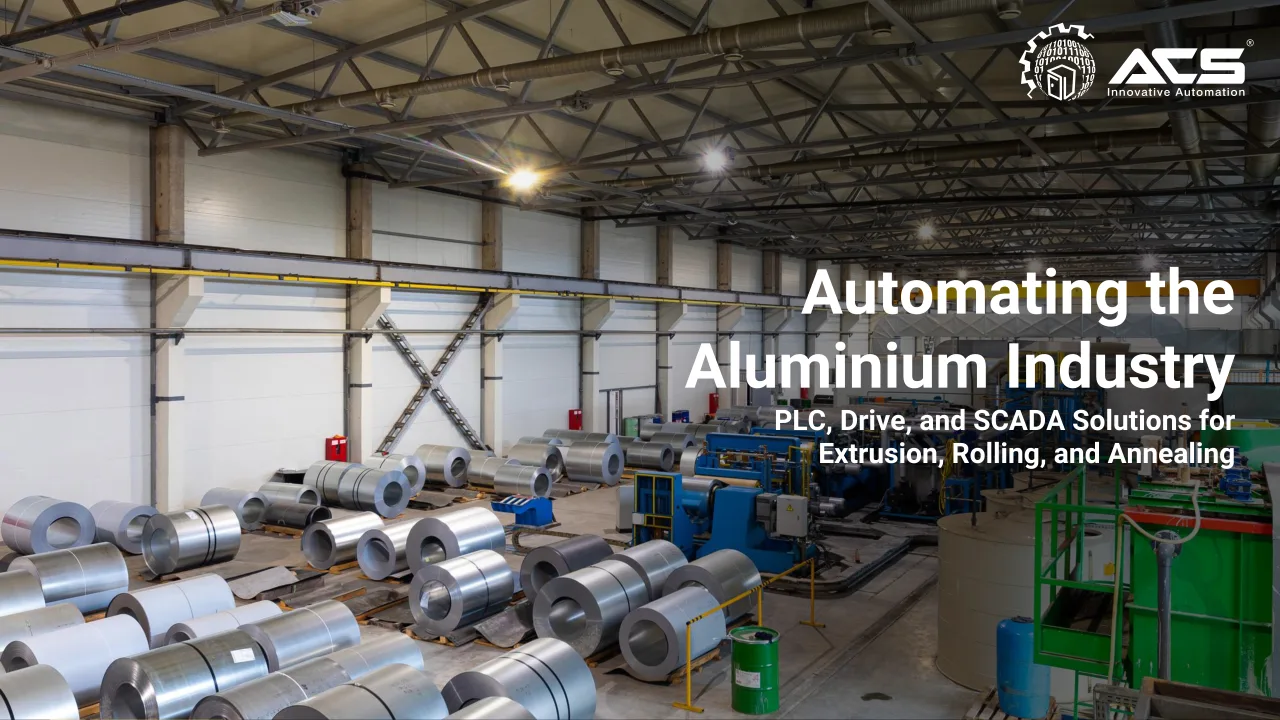
Automating the Aluminium Industry: PLC, Drive, and SCADA Solutions for Extrusion, Rolling, and Annealing
Introduction
The aluminium industry is one of the most technically demanding sectors in industrial manufacturing. Extrusion presses, cold rolling mills, hot rolling mills, foil rolling lines, annealing furnaces, casting equipment, and surface treatment lines all impose unique automation challenges combining high mechanical power, extreme temperature control precision, multi-axis synchronised motion, and the need for continuous, uninterrupted production. Getting the automation right is the difference between a profitable, high-quality operation and one plagued by material waste, product non-conformances, and unplanned stoppages.
ACS Engitech has accumulated deep domain expertise in aluminium industry automation through the design, supply, and commissioning of PLC control systems, drive panels, SCADA systems, and complete MCC/PCC panels for aluminium plants across India and internationally, including the commissioning of six annealing furnaces in Dhaka, Bangladesh. This blog describes the specific automation challenges and solutions in the key sub-processes of aluminium manufacturing.
Extrusion Press Automation
The Control Challenge
In aluminium extrusion, a heated aluminium billet is forced through a shaped die by a hydraulic press, producing profiles of defined cross-section. The quality of the extruded profile's dimensional accuracy, surface finish, and metallurgical properties depends critically on precise control of three interrelated variables: billet preheat temperature, press speed (ram speed), and the speed of the runout table that receives and stretches the extruded profile.
The Automation Solution
ACS Engitech implements a Siemens S7-1500 PLC as the central controller for extrusion press automation, integrating the following control functions:
- Billet Induction Heater Temperature Control: A closed-loop PID temperature controller implemented in the PLC using the Siemens CONT_C function block regulates induction heater output to achieve the specified billet temperature (typically 450–520°C for aluminium alloys) with accuracy within ±5°C. Type K thermocouples provide temperature feedback via Siemens analog input modules.
- Ram Speed Control: The hydraulic press ram speed is controlled via a proportional valve and position transducer (LVDT) feedback loop implemented in the PLC. Ram speed profiles are programmed as multi-segment ramps to optimise metal flow through the die and prevent surface cracking.
- Runout Table Speed Synchronisation: Servo drives or VFDs on the runout table conveyors are synchronised to the extrusion speed in real time, preventing profile buckling or excessive tension that would distort dimensional tolerances.
- Die Change Sequence Control: Automated guided die change sequences with interlocked axis motion reduce changeover time from hours to minutes, maximising press uptime.
ACS Engitech's extrusion press automation systems have demonstrated press productivity improvements of 15–25% through optimised billet heating, reduced scrap at press starts, and automated die change sequences.
Aluminium Rolling Mill Automation
Cold Rolling Mill Control Architecture
Cold rolling reduces aluminium strip to a precise thickness by passing it through one or more pairs of hardened work rolls under high rolling force. The automation challenge is formidable: maintaining strip thickness uniformity to within ±1 micron across rolls turning at speeds up to 2,000 m/min, while simultaneously controlling strip tension, flatness, and surface quality.
ACS Engitech implements rolling mill automation using Siemens S7-1500 PLCs with high-speed closed-loop modules and SINAMICS S120 multi-axis servo drive systems for main drive, tension reel, and uncoiler control. The key control loops are:
- Automatic Gauge Control (AGC): A high-speed feedback loop (cycle time 1–2 ms) that uses a capacitive or X-ray thickness gauge downstream of the roll gap to detect thickness deviations and instantly adjusts the hydraulic screw-down position (AGC feedback) or the roll gap set-point (feedforward from entry thickness). Thickness accuracy of ±2 microns is achievable with a well-tuned AGC system.
- Tension Control: Coiler and uncoiler tension is controlled to a precise set-point (typically 10–40 N/mm²) using SINAMICS drives in torque-controlled mode, with tension transducer feedback. Constant tension prevents strip breaks and ensures consistent mechanical properties throughout the coil length.
- Flatness Control: Electromagnetic or piezoelectric flatness rolls measure the tension distribution across the strip width, detecting profile defects such as centre buckle, edge wave, or quarter buckle. The PLC adjusts intermediate roll bending force or work roll tilting to correct flatness in real time.
Foil Rolling: Extreme Precision at High Speed
Aluminium foil rolling is the most demanding variant of cold rolling, producing strip as thin as 6 microns at mill speeds up to 2,500 m/min. At these thicknesses and speeds, the influence of oil film thickness, roll thermal crown, and strip tension on gauge uniformity becomes dominant. ACS Engitech's foil mill control systems implement advanced roll force feedforward control, adaptive gauge control with process model learning, and high-dynamic SINAMICS S120 multi-axis synchronised control for main drive, tension reels, and rolling oil circulation pumps.
Annealing Furnace Automation
The Thermal Process Challenge
Annealing is a controlled heat treatment process that softens work-hardened aluminium strip or coil by heating it to a precise temperature (typically 200–450°C depending on alloy and temper specification), holding it for a defined time, and then cooling it in a controlled manner. The metallurgical properties of the annealed material hardness, tensile strength, elongation, are directly determined by the accuracy of the temperature-time profile executed during annealing.
Furnace Control System Design
ACS Engitech has designed and commissioned annealing furnace control systems for both batch furnaces (where coils are loaded, heated, soaked, and cooled as a batch) and continuous annealing lines (where strip passes continuously through zones at defined speeds). The Siemens S7-1500 PLC implements:
- Multi-Zone Temperature Control: Large annealing furnaces are divided into multiple heating zones, each controlled by an independent PID loop using Type K or Type N thermocouples for temperature feedback and thyristor power controllers (TPCs) or SCR burner management systems for heating element or burner power modulation. Zone temperature accuracy of ±3°C is maintained throughout the soak period.
- Temperature Profile Programming: Operators define annealing recipes comprising heating rate (°C/hour), soak temperature, soak duration, and cooling rate via the HMI touchscreen. The PLC executes each recipe step as a ramp-and-soak sequence, with recipe storage for up to 100 different product specifications.
- Atmosphere Control: For bright annealing furnaces (where an oxidation-free surface finish is required), the PLC controls the nitrogen or hydrogen atmosphere flow rates and monitors dew point to maintain the protective atmosphere composition within specification.
- Safety Interlock Logic: Furnace safety interlocks gas supply pressure, combustion air pressure, door position, temperature high-high limit, and atmosphere purity are implemented as fail-safe logic. Any interlock fault initiates an automatic controlled shutdown sequence that prevents damage to the furnace or the material being processed.
ACS Engitech's international experience, including the commissioning of six batch annealing furnaces at a foil mill in Dhaka, Bangladesh, has given our team deep expertise in both the control engineering and the commissioning challenges that are unique to high-temperature aluminium thermal processing.
SCADA Integration: Plant-Wide Visibility for Aluminium Operations
Individual machine-level PLCs provide real-time control, but plant management requires a higher-level view of production performance across all process areas. ACS Engitech integrates Siemens WinCC-based SCADA systems with the plant PLC network to provide:
- Production Dashboard: Real-time display of current production speed, coil/billet identification, product specification, and production metre counters for each line.
- Quality Data Logging: Continuous recording of gauge, thickness, temperature, tension, and flatness data with coil-level traceability enabling quality certificates to be generated with actual process data for each production order.
- Alarm Management: Centralized alarm display and logging across all process areas, with operator guidance for alarm response and automatic escalation of unacknowledged critical alarms to shift supervisors.
- OEE Reporting: Automatic calculation of Availability, Performance, and Quality (OEE components) for each production line, enabling management to identify and eliminate the root causes of production losses.
- Maintenance Scheduling Integration: Runtime hour counters for rolls, bearings, hydraulic filters, and other wear components are logged in the SCADA historian, triggering preventive maintenance work orders at defined intervals.
Conclusion
The aluminium industry demands automation solutions that combine the highest levels of motion control precision, temperature control accuracy, and process data integrity implemented by engineers who understand both the automation technology and the metallurgical process it serves. ACS Engitech's track record of successful automation projects in extrusion, rolling, and annealing, spanning plants across India and internationally, demonstrates our capability to deliver automation systems that improve product quality, maximise plant throughput, and reduce operating costs in one of the industry's most technically demanding sectors. Contact ACS Engitech to discuss your aluminium industry automation requirements.
www.acsengitech.com