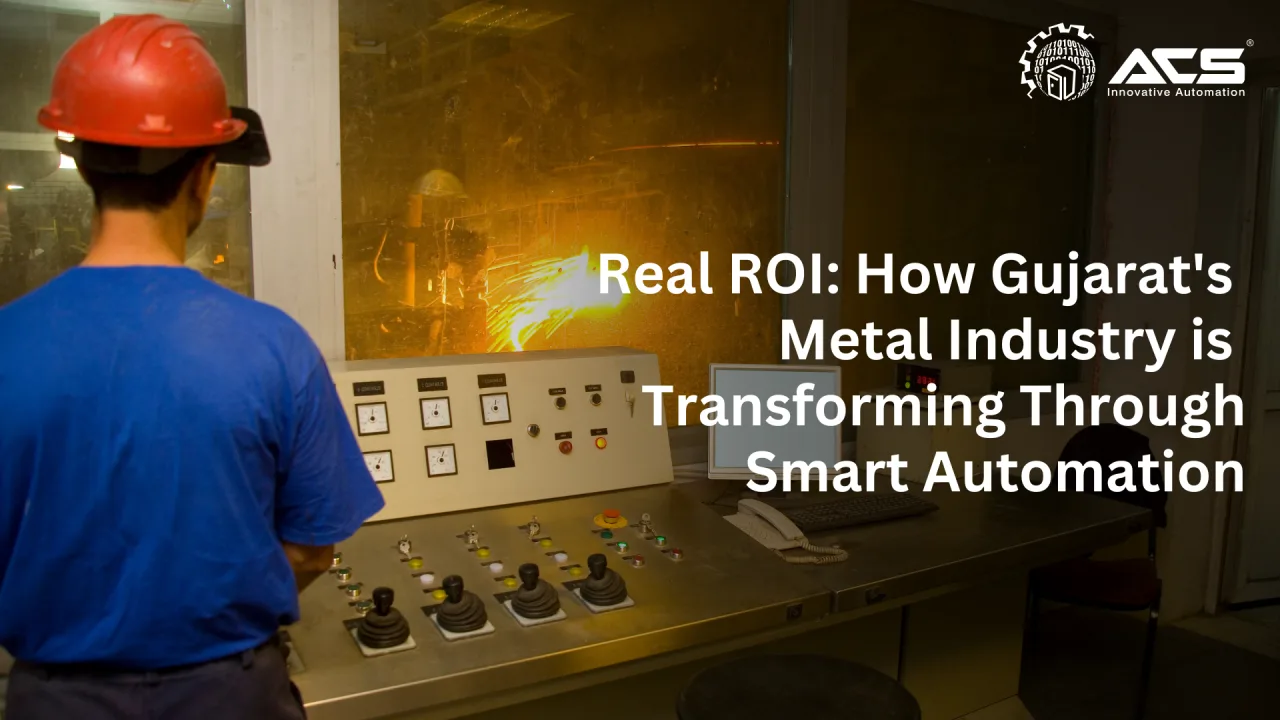
Real ROI: How Gujarat's Metal Industry is Transforming Through Smart Automation
Gujarat's metal industry stands at a pivotal crossroads. Long recognized as a manufacturing powerhouse, the sector now faces intensifying challenges from both domestic and international competitors. Rising energy costs, fluctuating raw material prices, and increasing quality demands are squeezing margins across the value chain—from primary metal production through fabrication and finishing.
Yet amid these challenges, forward-thinking metal manufacturers across Gujarat are discovering that smart automation delivers not just theoretical benefits but measurable returns on investment. Their experiences reveal a transformation that goes beyond incremental improvements to fundamentally reshape competitive capabilities.
The Automation Imperative in Metal Processing
The metal industry presents unique automation challenges. High temperatures, abrasive materials, and precision requirements create environments where conventional solutions often fall short. Yet these same challenges make the potential returns particularly significant.
Gujarat's metal sector spans diverse operations:
- Steel and aluminum rolling mills
- Foundries and casting operations
- Pipe and tube manufacturing
- Metal fabrication and machining
- Metal treatment and finishing
Across this spectrum, manufacturers are finding that targeted automation investments deliver returns through multiple avenues—often simultaneously improving quality, throughput, and resource utilization.
Key Transformation Areas Yielding Measurable Returns
1. Mill Automation and Tension Control Systems
For rolling mill operations, maintaining precise tension control throughout the process is critical for both product quality and operational efficiency.
A flat-rolled steel manufacturer in Kutch implemented a comprehensive mill automation system with advanced tension control algorithms that yielded remarkable results:
- 22% reduction in thickness variation
- 17% decrease in cobble incidents
- 8% increase in overall throughput
- 65% reduction in quality-related customer rejections
Their experience highlights how automation targeting core process parameters can simultaneously improve multiple performance metrics—delivering returns far exceeding the initial investment.
Payback Period: 11 months
2. Furnace Optimization Through Intelligent Control
Energy consumption represents one of the largest operating costs in metal processing. Intelligent furnace control systems are proving to be a high-return investment area.
A Gujarat-based aluminum extrusion company implemented adaptive furnace controls with real-time temperature profiling that:
- Reduced natural gas consumption by 14%
- Decreased temperature variation by 76% across the billet
- Improved die life by 28% due to more consistent material properties
- Reduced startup time by 35%
The integrated system paid for itself through energy savings alone, with quality improvements representing additional return.
Payback Period: 14 months
3. Quality Inspection Systems and Defect Detection
Traditional quality control in metal processing often relies on sampling methods that may miss intermittent defects. Advanced vision systems and non-destructive testing automation are changing this paradigm.
A precision tube manufacturer in Vadodara implemented an automated ultrasonic testing system with multi-parameter inspection capabilities:
- Defect detection rates improved by 89%
- Manual inspection labor reduced by 73%
- Production speeds increased by 26% with enhanced inspection confidence
- Customer quality claims decreased by 92%
The system not only improved quality outcomes but also increased production capacity by eliminating bottlenecks in the inspection process.
Payback Period: 9 months
4. Material Handling and Tracking Automation
The physical movement of metal products through processing stages presents both safety risks and efficiency challenges. Automated material handling systems address both concerns simultaneously.
A structural steel fabricator implemented a comprehensive material handling and tracking system that delivered:
- 68% reduction in material handling damage
- 42% decrease in workplace safety incidents
- 23% improvement in production throughput
- Near-elimination of material mixing errors
The integrated tracking component also simplified inventory management and customer order tracking.
Payback Period: 18 months
5. Cutting and Processing Optimization
Maximizing material yield is critical in an industry where raw material often represents 60-70% of product cost. Automated nesting and cutting systems are demonstrating compelling returns.
A sheet metal fabrication company in Ahmedabad implemented an intelligent nesting and cutting automation system:
- Material utilization improved by 12%
- Programming time reduced by 87%
- Setup time between jobs decreased by 63%
- Overall lead time for customer orders reduced by 41%
The material savings alone justified the investment, with the additional capacity representing pure upside.
Payback Period: 16 months
Implementation Strategies for Maximum Return
The most successful metal industry automation projects in Gujarat share several common elements:
Phased Implementation with Quick Wins First: Rather than attempting facility-wide transformation, successful projects typically begin with high-impact areas that deliver visible results.
Integration of Existing Equipment: Complete replacement of functional equipment rarely makes financial sense. The most successful projects integrate new automation with existing mechanical systems.
Focus on Data Connectivity: Ensuring automated systems can share data significantly multiplies their value, enabling both operational coordination and analytical insights.
Operator Engagement: Involving operators in the automation design process both improves the final solution and accelerates adoption.
Preventive Maintenance Integration: Building preventive maintenance capabilities into automation systems extends equipment life and prevents costly downtime.
One Jamnagar-based metal components manufacturer created a three-year automation roadmap but implemented it through 12 discrete projects, each with its own ROI case. This approach maintained momentum through visible wins while building toward greater integration benefits.
Overcoming Implementation Barriers
Despite compelling returns, many metal manufacturers hesitate to invest in automation. Common barriers include:
Initial Cost Perception: The upfront investment can appear daunting when viewed in isolation rather than against long-term returns.
Technical Expertise Gaps: Many facilities lack in-house expertise to specify and implement advanced automation.
Production Disruption Concerns: Fear of disrupting current production often delays implementation.
Integration Complexity: Concerns about integrating new systems with existing equipment and processes create hesitation.
Successful companies overcome these barriers through careful planning, partnership with experienced automation integrators, and phased implementation approaches that minimize disruption while demonstrating value.
A mid-sized foundry in Morbi partnered with an automation specialist to develop a five-year automation roadmap, breaking the journey into quarterly projects with defined ROI metrics. This approach made the transformation manageable and self-funding after initial investments.
The Automation Partner Difference
The complexity of metal industry automation makes the selection of implementation partners particularly critical. The most successful projects typically involve automation specialists with:
- Specific metal industry experience
- Understanding of process metallurgy principles
- Expertise in high-temperature and harsh environment applications
- Experience integrating mechanical, electrical, and software systems
A specialty steel producer in Ankleshwar spent six months selecting an automation partner for their critical transformation project. They ultimately selected a firm with proven metallurgical expertise over lower-cost alternatives—a decision they credit with saving millions through proper application design and implementation.
Looking Forward: The Emerging Competitive Advantage
As more Gujarat metal manufacturers embark on automation journeys, a clear competitive divide is emerging. Companies embracing smart automation are seeing multiple benefits compound over time:
- Quality improvements reduce warranty costs while commanding better pricing
- Efficiency gains enable competitive pricing while maintaining margins
- Process consistency allows entry into more demanding market segments
- Data insights drive continuous improvement in areas previously considered optimized
The transformation of Gujarat's metal industry through automation isn't just changing how products are made—it's redefining competitive capabilities in a global market where margin pressures continue to intensify.
The most forward-thinking manufacturers are discovering that smart automation isn't just about cost reduction—it's about creating new possibilities in product quality, consistency, and complexity that were previously unattainable.
About ACS Engitech Pvt. Ltd.: Established in 2009 in Ahmedabad, ACS Engitech has grown to become a leading automation solution provider specializing in machine automation, plant automation, and process automation. With extensive experience in metal industry applications, including successful implementations in rolling mills, pipe plants, and metal processing facilities across Gujarat, we understand the unique challenges and opportunities of the sector. As an authorized channel partner of SIEMENS for PLC & Drives Automation since 2014, our team combines technical expertise with industry knowledge to deliver automation solutions that generate measurable returns. Our 6000 sq. ft. manufacturing facility enables us to create customized control systems engineered specifically for the harsh environments of metal processing. To explore how strategic automation can transform your metal manufacturing operations, contact us at sales@acsengitech.com or visit www.acsengitech.com .
#MetalIndustry #IndustrialAutomation #Manufacturing #SmartAutomation #ROI #Gujarat #MetalProcessing #FactoryAutomation #DigitalTransformation #ManufacturingExcellence