
Variable Frequency Drives: The Most Underutilised Energy-Saving Tool in Indian Industry
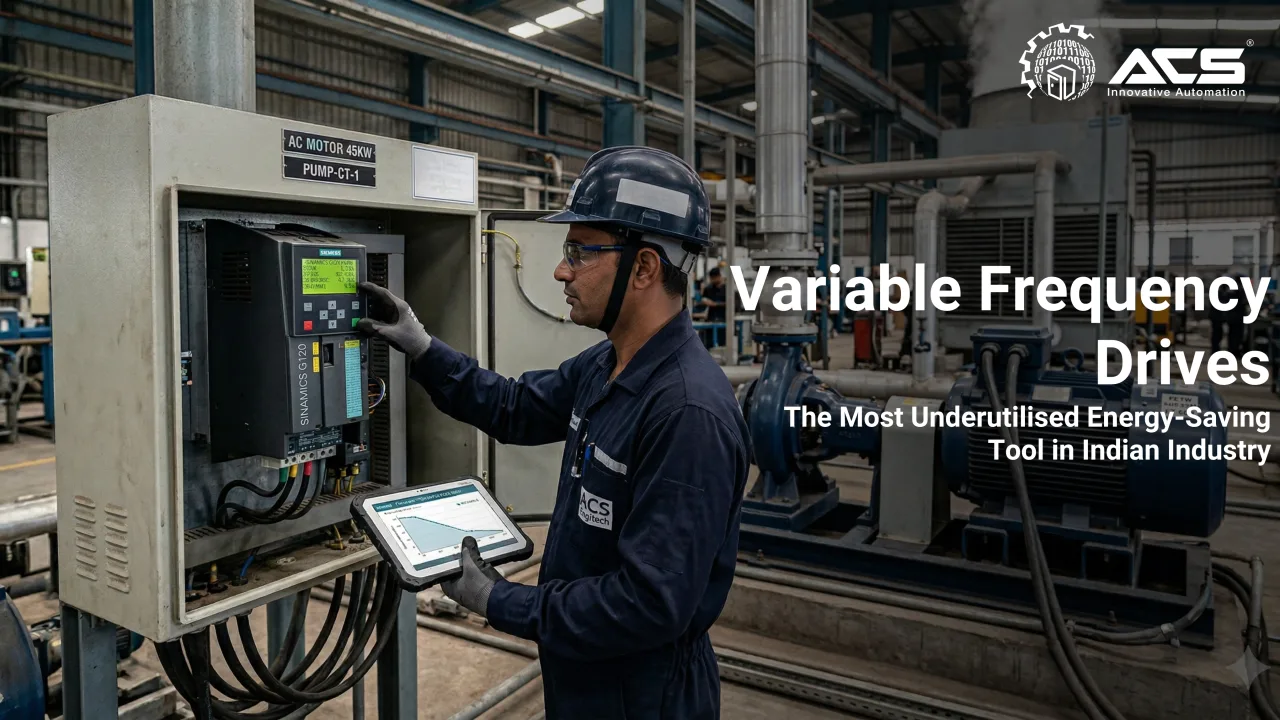
Most plants that have VFDs are not running them correctly. The ones that do not have them are paying for it on every electricity bill.
What is a Variable Frequency Drive?
A Variable Frequency Drive (VFD), also known as a Variable Speed Drive (VSD) or Adjustable Frequency Drive (AFD), is a power electronics device that controls the rotational speed of an AC induction motor by varying the frequency and voltage of the electrical supply delivered to the motor.
The operating principle is based on the fundamental relationship between motor speed and supply frequency:
Motor Speed (RPM) = (120 x Supply Frequency) / Number of Poles
A 4-pole motor at 50 Hz runs at 1,500 RPM (synchronous speed). Reduce frequency to 40 Hz, and the motor runs at 1,200 RPM.
The VFD converts a fixed-frequency AC supply to variable-frequency AC output using a Rectifier → DC Bus → IGBT Inverter topology.
The Physics That Makes VFDs So Powerful: The Affinity Laws
For centrifugal machines (pumps, fans, blowers, compressors), the relationship between speed and energy consumption is governed by the three Affinity Laws of fluid mechanics. These are fundamental physical laws, not marketing claims.
Flow Rate (Q) - Q is directly proportional to speed (N): Q2/Q1 = N2/N1
Head / Pressure (H) - Head is proportional to the SQUARE of speed: H2/H1 = (N2/N1)²
Power (P) - Power is proportional to the CUBE of speed: P2/P1 = (N2/N1)³
The Power Law is the most important. It means:
-49% Power when speed reduced by 20% (0.8³ = 0.512)
-78% Power when speed reduced by 40% (0.6³ = 0.216)
-66% Power when speed reduced by 30% (0.7³ = 0.343)
-88% Power when speed reduced by 50% (0.5³ = 0.125)
This is not a linear savings. It is an exponential one. A pump or fan that can run at 80% speed for 60% of its operating hours because demand fluctuates will achieve annual energy savings that typically justify the VFD investment within 12 to 24 months.
Where VFDs Deliver the Highest ROI
1. Pumps — Centrifugal and Axial Flow
Pumps are the single largest application for VFDs globally. In water supply, chemical dosing, cooling water circuits, and boiler feed systems, pump flow requirements are rarely constant. A pump running at 80% of full speed uses only 51% of the power of a pump running at full speed while delivering 80% of the flow.
Additionally, VFDs eliminate water hammer (pressure surge) by providing controlled acceleration and deceleration ramps, extending valve and pipe system life significantly.
2. Fans and Blowers Cooling Towers, Furnaces, Ventilation
Industrial fans are dramatically oversized by design they are engineered for peak load conditions that occur infrequently. The rest of the time, dampers or inlet guide vanes are used to reduce airflow, wasting the energy that has already been delivered to the motor.
Replacing damper-based flow control with VFD speed control on a large cooling tower fan (typically 55 kW to 160 kW) commonly yields 30–50% annual energy savings.
3. Compressors
Air compressors in manufacturing facilities are frequently oversized. Load-unload control (the compressor runs at full speed and vents pressure when not needed) is significantly less efficient than VFD-based modulating control, where the compressor speed matches actual air demand in real time.
4. Conveyor Systems
Conveyor speed control enables process synchronisation, matching belt speed to upstream and downstream equipment, reducing mechanical wear, and allowing smooth starts that extend gearbox and coupling life.
The Siemens VFD Portfolio: Technical Overview
At ACS Engitech, we are an authorised Siemens System House and work primarily with the following Siemens drive series:
Drive Series
Specifications & Applications
Siemens SINAMICS G120
- 0.37 kW to 250 kW. Modular design with separate Control Unit (CU) and Power Module (PM). PROFINET/PROFIBUS/USS integrated. Safety Integrated (SIL2) functions available. Ideal for conveyor, pump, fan, and compressor applications.
Siemens SINAMICS V20
- 0.12 kW to 30 kW. Compact, cost-effective. Quick commissioning via BOP-2 panel. Modbus RTU communication. Ideal for small pumps, fans, and mixers in budget-sensitive applications.
Siemens SINAMICS G120C
- Compact version of G120; integrated drive with all functions in one unit. 0.55 kW to 132 kW. PROFINET standard. Ideal for panel space-constrained applications.
Siemens SINAMICS S120
High-performance multi-axis drive system for coordinated motion control applications. Servo and vector control. Ideal for rubber, plastics, and printing machinery.
Common Mistakes in VFD Deployment
Having a VFD installed is not the same as running it optimally. The following errors are common in plants that have VFDs but are not realising their full energy benefit:
- VFD set to fixed-speed output (e.g., always running at 50 Hz) — effectively defeating the purpose; should be in auto/PID mode responding to process feedback
- No process feedback sensor — VFD runs open-loop without a pressure transmitter, flow meter, or level sensor to regulate against
- Incorrect motor parameters entered at commissioning — leading to poor torque control and thermal protection errors
- PID parameters not tuned — resulting in hunting (oscillation) around the setpoint rather than stable regulation
- Missing output reactor or dU/dt filter — causing premature motor insulation failure from high-frequency switching voltage spikes (especially for cable runs over 50 m)
VFD Integration with PLC and SCADA
A VFD operating in isolation provides speed control. A VFD integrated into a PLC-SCADA system provides intelligent, process-responsive energy management.
Siemens SINAMICS G120 drives with PROFINET communication enable the following from the PLC and SCADA layer:
- Remote speed setpoint command (from PLC output or SCADA operator input)
- Real-time monitoring of motor speed, output current, DC bus voltage, and active power
- Fault code reading and acknowledgement via network (no physical access required)
- Drive parameter read/write from the SCADA engineering station
- Integrated energy metering — kWh logged per drive, enabling per-motor energy reporting
Calculating Your VFD Payback: A Worked Example
Example: 30 kW Cooling Tower Fan, running 18 hours/day, 330 days/year
Current state: DOL, full speed. Energy = 30 kW x 18 h x 330 d = 1,78,200 kWh/year
Post-VFD: Average speed 80% of rated. Power = 30 x 0.8³ = 15.4 kW. Energy = 15.4 x 18 x 330 = 91,476 kWh/year
Annual saving: 86,724 kWh x ₹8/unit = ₹6.94 lakh/year
Siemens G120 VFD cost (installed): ₹2.2 lakh. Simple payback: ~4 months.
Conclusion: The VFD is Not an Upgrade. It is a Baseline
In 2025, running centrifugal pumps, fans, and blowers on Direct-On-Line starters without speed control is not a standard operating practice it is an avoidable inefficiency. With electricity tariffs in India's industrial sector ranging from ₹7 to ₹12 per kWh and rising, the energy cost exposure of an uncontrolled motor fleet is substantial and compounding.
The VFD is not an exotic technology. It is a mature, reliable, and widely available solution. What is needed is a correct specification, proper installation, accurate commissioning, and integration with the plant control architecture.
ACS Engitech provides VFD supply, panel integration, PLC programming for drive control, and SCADA energy monitoring. We work with Siemens SINAMICS G120, V20, and S120 drives across pump, fan, conveyor, compressor, and process machinery applications.
www.acsengitech.com
#VFD #VariableFrequencyDrive #EnergyEfficiency #Siemens #SINAMICS #G120 #V20 #MotorControl #IndustrialAutomation #ACSEngitech