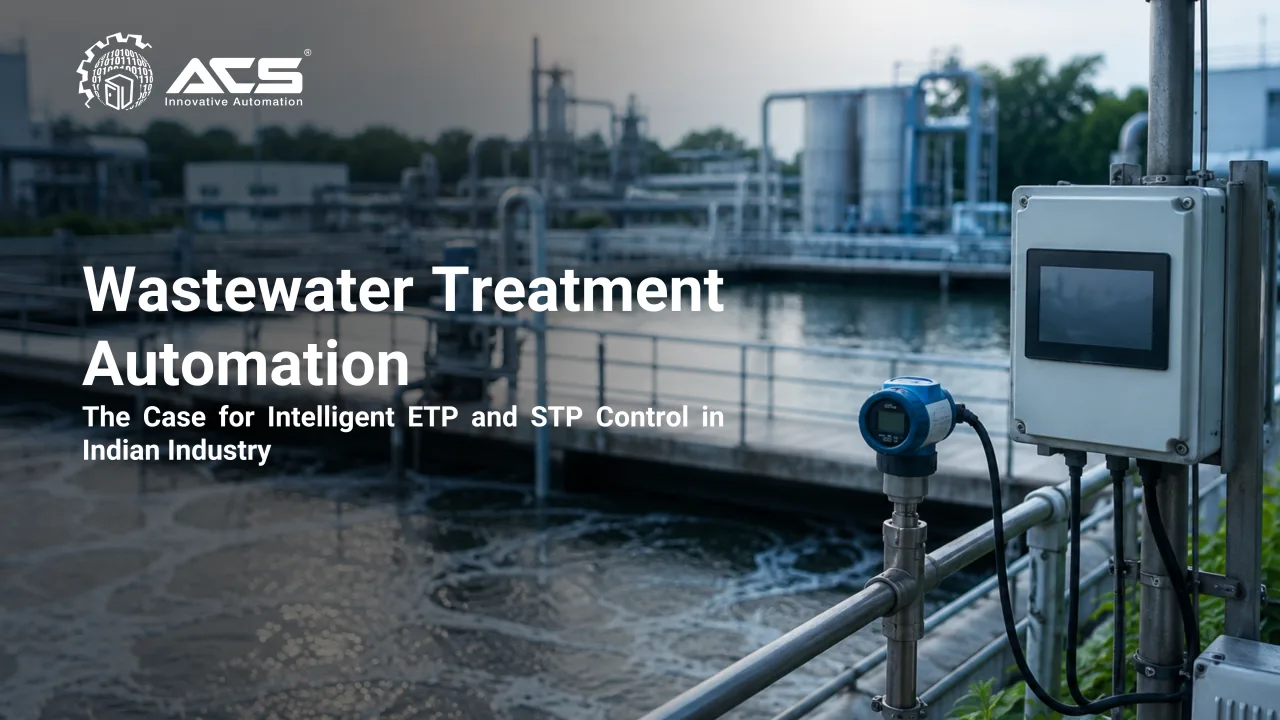
Wastewater Treatment Automation: The Case for Intelligent ETP and STP Control in Indian Industry
India's Central Pollution Control Board (CPCB) requires continuous online effluent monitoring for certain categories of industries. The question is not whether to automate your ETP. It is how soon you can afford not to.
The Regulatory Context
India's environmental regulatory framework for industrial wastewater has tightened significantly over the past decade. The key legislative instruments governing effluent discharge are:
- Environment Protection Act, 1986 — empowers CPCB and SPCBs (State Pollution Control Boards) to set discharge standards
- Water (Prevention and Control of Pollution) Act, 1974 prohibits the discharge of pollutants into water bodies without consent
- CPCB's Online Continuous Effluent/Emissions Monitoring System (OCEMS) mandate requires real-time data transmission to CPCB servers for 17 categories of Highly Polluting Industries (HPIs)
For large industries in categories including textile, distilleries, sugar, tanneries, pharmaceuticals, and pulp & paper, online monitoring with automated data logging is not optional it is a legal compliance requirement with facility closure as a potential penalty for non-compliance.
For smaller industries, the trend is clear: consent conditions increasingly reference automated monitoring, and SPCB inspection protocols are becoming more data-intensive.
The Three Types of Industrial Wastewater Treatment Facilities
ETP (Effluent Treatment Plant) - Treats industrial process wastewater before discharge or recycling. Parameters: pH, COD, BOD, TSS, heavy metals, oil & grease. Highly variable inlet load automation critical for dosing accuracy.
STP (Sewage Treatment Plant) - Treats domestic wastewater from industrial townships, campuses, and commercial facilities. Parameters: BOD, COD, TSS, faecal coliform. Process is more stable than ETP automation, which improves consistency and reduces operator dependence.
CETP (Common ETP) - Shared effluent treatment for industrial clusters (GIDC, etc.). Multiple inlet streams with different characteristics. The most complex automation requirement is multi-source inlet monitoring and proportional dosing.
The Key Process Stages and Their Automation Requirements
Stage 1: Inlet Monitoring and Flow Measurement
Every ETP begins with characterising the incoming wastewater stream. Manual grab sampling provides a snapshot, but batch industries discharge variable loads that can change within hours. Automated inline analysers provide continuous characterisation:
- Electromagnetic flow meters — accurate flow measurement for influent and treated water
- pH/ORP (Oxidation-Reduction Potential) sensors — continuous measurement for dosing control
- COD/BOD online analysers — spectrophotometric or UV absorption-based- provide real-time organic load data
- TSS (Total Suspended Solids) sensors — optical measurement for solids loading
- Temperature and conductivity sensors — process quality indicators and CPCB-required parameters
Stage 2: Chemical Dosing — The Case for PLC-Based Proportional Control
Chemical dosing is the highest-cost-impact process in ETP operation. Incorrect dosing, either under-dosing or over-dosing, has immediate consequences:
- Under-dosing: Inadequate pH correction, insufficient coagulant, and poor settling of treated water fail discharge standards
- Over-dosing: Excessive chemical consumption (direct cost), creation of secondary waste, potential for adverse reactions
Manual dosing practices fixed doses based on shift schedules, regardless of actual load, are inherently imprecise. PLC-based proportional dosing ties chemical addition directly to real-time sensor readings:
PID Control Loop: If inlet pH < 6.5, the PLC commands the caustic dosing pump to run at a speed proportional to the pH deviation. As pH rises toward setpoint, pump speed reduces. At setpoint, dosing stops.
This closed-loop approach typically reduces chemical consumption by 20-35% compared to fixed-schedule manual dosing.
Dosing pump control is implemented via a 4-20 mA analogue output from the PLC to a VFD-driven metering pump or a pulse-width modulated solenoid dosing pump.
Stage 3: Aeration Control Energy Optimisation via DO Measurement
Biological treatment (Activated Sludge Process, Sequencing Batch Reactor, MBBR) is the most energy-intensive stage of ETP/STP operation. Aeration blowers or surface aerators supply oxygen to the biological treatment zone, consuming 50–70% of the total ETP electrical energy budget.
The fundamental control parameter is Dissolved Oxygen (DO), the concentration of oxygen available for biological activity in the treatment tank. The optimal DO range for aerobic biological treatment is 1.5 to 3.0 mg/L. Running at higher DO wastes blower energy; running lower compromises treatment.
Automated DO-based aeration control:
- DO sensor (optical membrane or Clark cell type) continuously measures the tank DO
- PLC implements a PID loop: if DO > setpoint, reduce blower VFD speed; if DO < setpoint, increase speed
- Blower operates at the minimum speed needed to maintain target DO, not at full speed continuously
Typical energy saving from DO-based aeration control: 25–45% of blower energy cost, depending on the variability of the organic load.
Stage 4: Sludge Management and Decanting
Sludge handling thickening, filter press dewatering, and sludge pumping benefit significantly from PLC automation through:
- Level-controlled sludge pumping — pumps start and stop based on sludge hopper level, not manual judgment
- Filter press cycle automation — automatic cloth washing, press/release sequencing, filtrate return
- Sludge volume tracking — totalised flow logging for sludge disposal records and CPCB reporting
The SCADA Architecture for ETP Monitoring
A complete ETP automation system integrates multiple field devices into a unified monitoring and control platform. The typical architecture for an automated ETP at ACS Engitech includes:
Field Instruments - PH/ORP sensors, DO sensors, flow meters, level transmitters, turbidity sensors, temperature sensors, COD analysers
PLC Control Panel - Siemens S7-1200 or S7-1500 PLC; analogue input modules for sensor signals; digital I/O for pump and valve control; VFD communication via PROFINET
HMI - Siemens KTP700 or KTP900 touchscreen; P&ID mimic of ETP process; real-time parameter display; alarm management; manual override functions
SCADA / Historian - WinCC or equivalent; trend logging for all parameters; report generation for CPCB compliance; remote access via secure VPN
CPCB OCEMS Interface - Automated data transmission to CPCB portal (where applicable); parameter logging in CPCB-specified format
Remote Monitoring: The Operational Game-Changer
ETP and STP facilities are typically located at the boundary of industrial premises, staffed by a single operator, and subject to the highest penalty risk of any operational failure on site. Remote monitoring transforms this situation:
- Real-time parameter visibility from mobile or desktop — operations manager, EHS officer, or plant head can monitor ETP status from anywhere
- SMS and email alarm escalation — when pH, DO, or TSS goes out of range, the right person is notified within seconds
- Remote dosing adjustment — if the load changes on a public holiday, the dosing setpoint can be adjusted remotely without sending someone to the site
- Automatic CPCB data push — OCEMS data transmitted automatically at required intervals without operator intervention
Common Sectors and Their Specific Challenges
Textile / Dyeing - High pH variation and colour (COD from dyes); requires automated pH control and coagulation dosing
Chemical / Agrochemical - Wide range of pollutants; high COD; toxic load spikes; requires robust online monitoring and safety interlocks
Pharmaceutical - Strict discharge standards; solvent traces; requires advanced treatment with precise process control
Food & Beverage - High BOD from organic waste; strong seasonal variation in load; requires adaptive biological treatment control
Metal Finishing / Electroplating - Heavy metals (Cr, Cu, Ni, Zn); pH adjustment and precipitation; sequential treatment with precise reagent dosing
The ROI of ETP Automation
20-35% Reduction in chemical consumption via PID dosing control
100% Audit-ready compliance data, no manual logbooks
25-45% Reduction in aeration energy via DO-based blower VFD control
0 % Manual readings needed with continuous online monitoring
Conclusion: Your ETP Deserves the Same Engineering Rigour as Your Production Line
The effluent treatment plant is the last line of environmental defence for an industrial facility. Its failure in treatment performance, in compliance reporting, or in operational visibility carries regulatory, financial, and reputational consequences.
The irony is that many facilities invest heavily in production automation while running their ETP on manual controls and clipboard logs. The engineering rigour applied to a production line, real-time monitoring, closed-loop control, automated data logging, and alarm management is equally appropriate and equally valuable for effluent treatment.
With modern PLC-SCADA systems, the tools to automate ETP operation are mature, cost-effective, and fully compliant with India's regulatory reporting requirements. The investment delivers chemical cost savings, energy savings, compliance assurance, and operator productivity gains simultaneously.
ACS Engitech provides complete ETP and STP automation solutions: process instrumentation, PLC control panels, SCADA, HMI, remote monitoring, and CPCB OCEMS integration. We have experience across textile, chemical, pharmaceutical, and food & beverage sectors.
www.acsengitech.com
#WastewaterTreatment #ETP #STP #ProcessAutomation #CPCB #EnvironmentalCompliance #SCADA #Siemens #ACSEngitech #IndiaManufacturing