
What Is SCADA and How Does It Transform Modern Plant Operations?
Introduction
Supervisory Control and Data Acquisition SCADA is one of the most powerful technologies in the industrial automation toolkit. Yet despite its widespread deployment, many plant managers and engineers still have an incomplete understanding of what SCADA actually does, how it is architected, and why it delivers such significant operational value. This blog provides a comprehensive, technically accurate overview of SCADA systems, their components, and their transformative impact on plant operations.
What SCADA Is (and Is Not)
SCADA is a software-based supervisory system that collects data from field devices, sensors, PLCs, remote terminal units (RTUs), and intelligent electronic devices (IEDs), processes this data in real time, and presents it to operators through graphical displays called Human-Machine Interfaces (HMIs) or operator workstations. Critically, SCADA provides both monitoring (data collection and visualization) and control (the ability to send commands to field devices from a central location).
SCADA is not a replacement for PLCs. The PLC is the real-time controller that executes logic at the machine or process level in milliseconds. SCADA sits above the PLC, providing plant-wide visibility, data logging, alarm management, and supervisory control, typically with cycle times in the range of 0.5–5 seconds.
The Four Layers of a SCADA Architecture
Layer 1: Field Instrumentation
At the lowest layer are physical sensors and actuators: temperature transmitters (RTDs, thermocouples), pressure sensors, flow meters (electromagnetic, Coriolis, ultrasonic), level transmitters, valve positioners, and motor drives. These devices generate the raw process data that feeds the entire SCADA system. Signal conditioning hardware at this layer converts 4–20 mA, HART, Profibus PA, or Foundation Fieldbus signals into forms readable by the control system.
Layer 2: PLCs and RTUs
Programmable Logic Controllers (PLCs) and Remote Terminal Units (RTUs) are the local intelligence of the system. PLCs execute control logic, PID control loops, interlock sequences, motor control — and communicate with the SCADA server via industrial Ethernet (PROFINET, Modbus TCP, OPC UA) or serial protocols (Modbus RTU, Profibus DP). At ACS Engitech, Siemens S7-1200 and S7-1500 PLCs are typically deployed at this layer.
Layer 3: SCADA Server and Communication Infrastructure
The SCADA server is the central nervous system. It polls PLCs for data, stores values in a real-time database (the process historian), evaluates alarm conditions, executes supervisory control algorithms, and communicates with operator workstations. The communication infrastructure at this layer typically uses industrial Ethernet, with OPC UA (OPC Unified Architecture) as the preferred, vendor-neutral data exchange standard.
Layer 4: Operator Workstations and Reporting
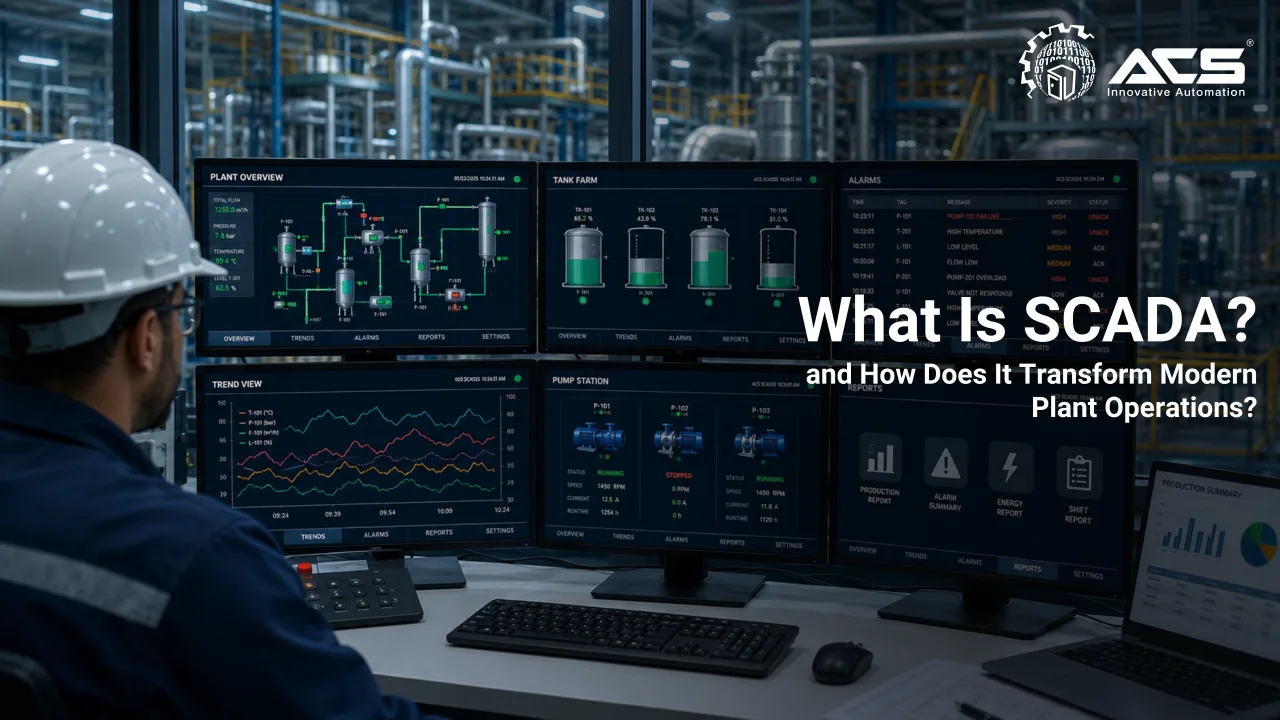
Operators interact with the plant through graphical displays, process flow diagrams (PFDs), trend graphs, alarm lists, and control faceplate panels on operator workstations. Modern SCADA systems also provide web-based thin client access, allowing authorized personnel to monitor plant status from any location using a standard browser, without installing dedicated software.
ACS Engitech delivers web-based SCADA solutions with a completely new graphical interface and object-oriented data architecture, providing a centralized database for all plant information accessible from anywhere.
Key Functional Capabilities of Modern SCADA
Real-Time Process Visualization
Dynamic graphical displays show the current state of all process variables, tank levels, pipe flows, motor statuses, and valve positions updated in near real time. Color coding, animation, and trend overlays give operators immediate situational awareness.
Alarm Management
SCADA systems implement ISA-18.2-compliant alarm management. Alarm rationalization ensures that each alarm is actionable, uniquely identifies a specific abnormal situation, and triggers the correct operator response. Alarm flooding, where operators are overwhelmed by cascading alarms during process upsets, is prevented through alarm prioritization and suppression logic.
Historical Data Logging and Trend Analysis
The process historian stores time-stamped values for all monitored variables, typically at 1-second resolution. Historical trend comparison allows engineers to analyse process behaviour over weeks or months, identify degradation trends (bearing wear, heat exchanger fouling, pump efficiency decline), and make data-driven maintenance decisions.
Report Generation
SCADA systems automatically generate production reports, batch records, shift summaries, and energy consumption reports — eliminating manual data collection and the associated transcription errors. Integration with ERP systems such as SAP enables seamless data flow from the plant floor to the business management layer.
SCADA in Practice: Industries Served by ACS Engitech
ACS Engitech has deployed SCADA solutions across a range of industries, including:
- Aluminium Industry: Monitoring and control of extrusion lines, annealing furnaces, foil rolling mills, and casting operations, including international deployments such as the 6-furnace Annealing system commissioned in Dhaka, Bangladesh.
- Water and Wastewater Treatment: SCADA-based monitoring of pumping stations, dosing systems, filtration banks, and effluent quality parameters in compliance with environmental regulations.
- Steel and Rolling Mills: High-speed data acquisition from rolling mill drives, combined with thickness and temperature control via SCADA-PLC integration.
- Cement Industry: SCADA systems in the Cement Industry provide real-time, centralized monitoring and control of production, including stacker & reclaimer, raw material preparation, kiln operation, and grinding.
Conclusion
SCADA is the command centre of the modern industrial plant. By providing real-time visibility, centralised control, and deep historical insight into plant operations, SCADA systems enable plant managers and process engineers to reduce downtime, improve product quality, optimise energy consumption, and make faster, better-informed decisions. ACS Engitech's SCADA solutions, built on industry-leading platforms and integrated with Siemens PLCs via proven communication architectures, deliver the operational intelligence that today's competitive industries demand.
www.acsengitech.com